Key Takeaways
- Elk Ridge Recovery is out-of-network with UnitedHealthcare, but many UHC plans, especially PPOs, still pay a meaningful share of residential treatment through out-of-network behavioral-health benefits.
- A facility ‘accepting’ UnitedHealthcare only means it will bill your plan; whether your specific plan covers the care is a separate approval that determines your actual bill.
- Your plan type shapes verification: employer group plans carry parity leverage, Marketplace plans guarantee behavioral-health coverage, Medicare Advantage often adds authorization, and Community Plan Medicaid rarely covers out-of-network care.
- Pull your Summary of Benefits and Coverage before calling so you can identify your deductible, coinsurance, out-of-pocket maximum, and behavioral-health rows in plain language 5.
- Call UHC member services with eight specific questions covering out-of-network benefits, allowed-amount methodology, prior authorization, and MAT rules, and request a reference number plus written medical necessity criteria 3.
- Translate the numbers into real dollars by stacking deductible, coinsurance, and out-of-pocket maximum, and ask about balance billing tied to how UHC calculates the allowed amount.
- Understand that prior authorization and medical necessity are standard checkpoints, not roadblocks, and under 2024 parity rules SUD requirements cannot be stricter than comparable medical care 2.
- If coverage is denied, delayed, or partial, use the roughly 180-day internal appeal window, request external review, and consider Montana’s insurance commissioner or braided funding options 3, 13.
The Question Behind the Question: Will This Actually Be Paid For?
You typed “United Healthcare drug rehab coverage” into a search bar. Somewhere behind that phrase is a quieter question: can I actually afford to get help, or is this door closed before I even knock?
That question is heavy. It’s also incredibly common. A 2025 peer-reviewed study of adults with group-based private insurance found that roughly 39% did not know whether their plan covered drug treatment 12. That’s people with insurance cards in their wallets, sitting with the same uncertainty you’re sitting with right now. If you feel behind because you don’t already know your benefits, you’re not. Most people don’t.
Here’s what this guide will do. You’ll get a straight answer about where Elk Ridge Recovery stands with UnitedHealthcare, a plain-language walkthrough of how to verify your specific plan, the exact questions to ask when you call the member number on the back of your card, and what to do if the first answer isn’t the one you hoped for.
One small promise before we start: you do not have to understand insurance to take the next step. You just have to be willing to make one phone call, or let someone make it with you. That’s the whole ask right now.
The Honest Starting Point: Elk Ridge Is Out-of-Network with UnitedHealthcare
Before you spend another minute researching, here’s the truth other rehab pages tend to bury: Elk Ridge Recovery is not in-network with any insurance carrier, and that includes UnitedHealthcare. No hidden footnote, no asterisk. That’s the starting line.
Read that again and let it settle, because it sounds worse than it actually is. Out-of-network does not mean uncovered. Many UnitedHealthcare plans, especially PPO plans, include real out-of-network behavioral-health benefits. That means your plan may still pay a meaningful share of residential treatment, detox, PHP, or IOP at Elk Ridge, even though the facility sits outside UHC’s contracted network. Whether it does, and how much, depends on the specific plan tied to the member ID on your card.
So the honest question isn’t “Does Elk Ridge take UnitedHealthcare?” The honest question is “Does my UnitedHealthcare plan include out-of-network residential substance-use benefits, and what will my share of the cost be?” That’s a very answerable question, and the rest of this guide walks you through getting the answer. You don’t have to solve it alone, and you don’t have to solve it today. One step at a time is enough.
Accepting Insurance vs. Covering Your Care: Two Different Questions
There’s a phrase you’ll see on a lot of rehab websites: “We accept UnitedHealthcare.” It sounds like a green light. It isn’t, quite. It’s more like a facility saying, “Yes, we’re willing to bill your insurance company.” That’s a real thing, but it’s not the same as your plan agreeing to pay.
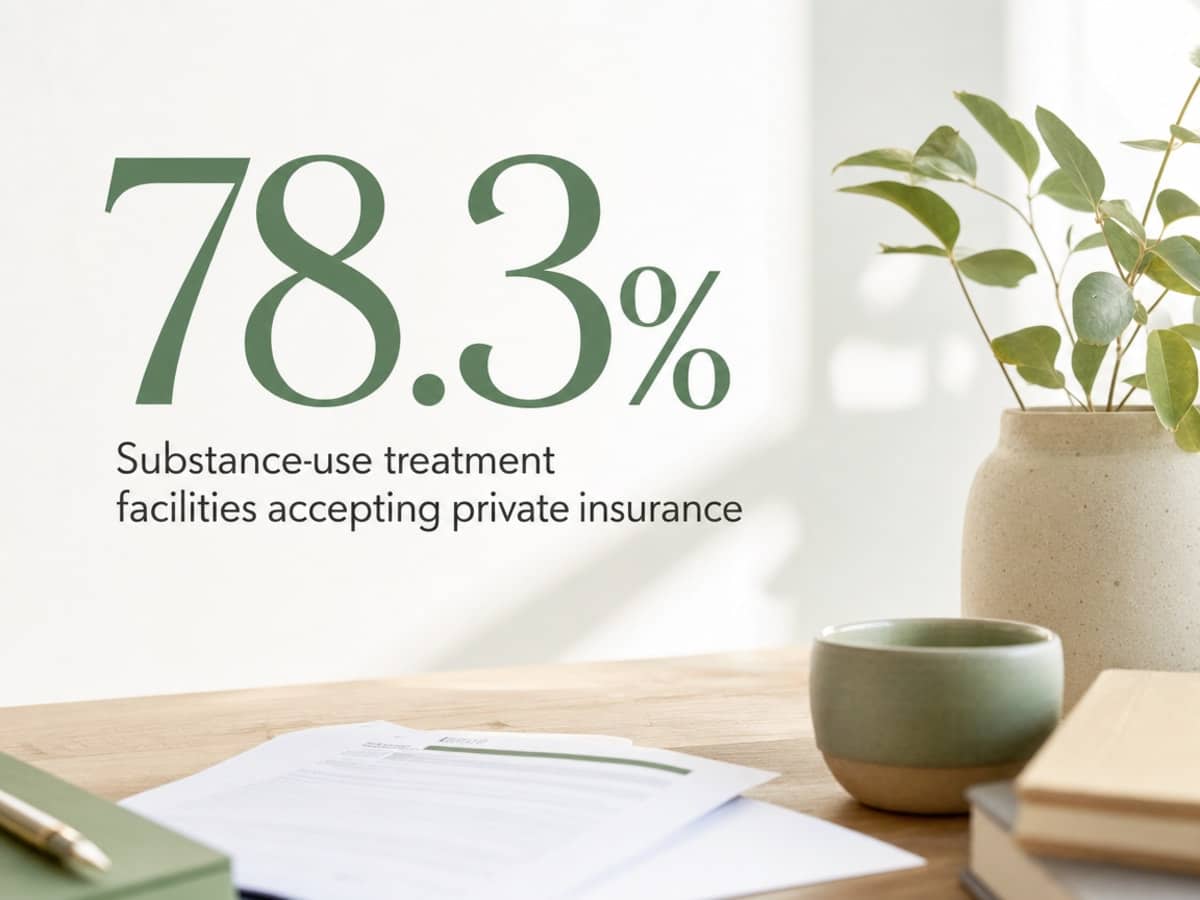
Acceptance is common. The 2024 National Substance Use and Mental Health Services Survey found that 78.3% of substance-use treatment facilities reported accepting private insurance as a form of payment 8. Most doors are open, in that sense. What varies wildly is what happens once you walk through them and the billing starts.
Here’s the split that matters for you. “Accepting” your insurance means a facility will submit claims to UnitedHealthcare on your behalf. “Covering your care” means your specific plan agrees the service was medically necessary, applied at the right level of care, delivered by a provider your plan will pay for, and priced within what your plan considers reasonable. Those are two separate approvals, and only the second one determines your bill.
Elk Ridge Recovery falls into the first bucket for UnitedHealthcare members: the admissions team will work with UHC, submit claims, and pursue authorization. Whether your plan covers the care is the question we’ll help you answer in the next few sections. That’s the part worth your energy.
What Your Plan Type Changes About Verification
Employer Group Plans (Including Self-Funded ERISA Plans)
If your UnitedHealthcare card came through work, your plan is a group plan. Some of these are fully insured, meaning UHC decides the benefits. Many, especially at larger employers, are self-funded, meaning your employer pays claims and UHC just administers them. On paper it looks identical. Behind the scenes, the rules can differ.
Group plans generally fall under the Mental Health Parity and Addiction Equity Act, which requires plans to treat substance-use benefits comparably to medical benefits, including things like prior authorization and network rules 1, 2. That’s your leverage. When you call, you can request the plan’s written medical necessity criteria and the comparative analysis of any prior authorization requirements. The Department of Labor’s consumer guide confirms this information generally must be provided within 30 days of a written request 3. Keep a copy. It becomes ammunition if you need to appeal later.
UHC Individual and Marketplace Plans
If you bought your UHC plan on Healthcare.gov or a state exchange, or directly from UHC as an individual, you’re on a Marketplace-style plan. The good news here is a floor of protection: Marketplace plans must cover behavioral-health treatment, including mental-health and substance-use inpatient and outpatient care, as essential health benefits 4, 10. They also cannot impose annual or lifetime dollar limits on those benefits 4.
That floor is real, but it’s not a ceiling on your costs. Deductibles, coinsurance, out-of-network reimbursement rates, and prior authorization rules still vary plan to plan. A bronze plan and a gold plan both cover residential treatment as a category, but the amount you’d pay at Elk Ridge could differ by thousands. That’s why the Summary of Benefits and Coverage matters so much for this group of readers. We’ll get to it in the next section.
UnitedHealthcare Medicare Advantage
If your UHC card says Medicare Advantage, or if you’re helping a parent whose card does, the verification conversation shifts. Medicare Advantage plans are allowed to require prior authorization for behavioral-health services in ways traditional Medicare generally does not 7. That means one extra approval step can sit between you and admission, and it needs to be handled up front, not after the fact.
A 2024 GAO review of Medicare Advantage plans found that 28% of reviewed plans required prior authorization for behavioral-health telehealth services, alongside authorization requirements for other levels of care 6. That number is specific to Medicare Advantage plans reviewed by GAO. It does not apply to commercial UHC, Marketplace UHC, or Medicaid UHC. But it tells you what to expect if you’re on MA: ask directly whether authorization is required before admission for detox, residential, or PHP, and whether continued-stay reviews will happen during treatment.
UnitedHealthcare Community Plan (Medicaid) Members
If your card reads UnitedHealthcare Community Plan, you’re covered through a state Medicaid managed-care contract. This is where the out-of-network conversation gets hardest. Medicaid managed-care plans typically restrict coverage to in-network providers, and Elk Ridge is not in-network. Coverage at Elk Ridge on a UHC Community Plan is unlikely without a single-case agreement approved in advance.
That doesn’t mean the call is wasted. Ask specifically about out-of-network residential SUD benefits, single-case agreements, and whether the plan will authorize a facility outside the network when in-network options are unavailable or inappropriate. If the answer is no, Elk Ridge’s admissions team can talk with you about other paths, including the braided funding options we cover later in this guide.

Pull the Summary of Benefits and Coverage First
Before you call anyone, find one document. It’s called the Summary of Benefits and Coverage, or SBC. Every job-based and individual health plan is required to give you one, in plain language 5. It’s usually four to eight pages. If you have online access to your UHC account, it’s a PDF download. If your plan came through work, your HR or benefits person can email it to you the same day. If you don’t have either, call the member number on your card and ask them to send it.
When you open it, look for four specific things and mark them with a highlighter or a pen:
– Your deductible — the amount you pay before your plan starts sharing costs. Look for both in-network and out-of-network numbers. They’re usually different.- Your coinsurance — the percentage you pay after the deductible is met. Again, in-network and out-of-network are listed separately.- Your out-of-pocket maximum — the ceiling on what you’ll pay in a plan year. This is the number that protects you.- The mental health and substance use service rows — these show whether the categories are covered and hint at authorization rules.
The SBC won’t tell you everything. It won’t spell out how UHC calculates out-of-network reimbursement or list every prior authorization trigger 5. But it gives you the vocabulary and the ballpark numbers you’ll need for the call. Ten minutes with this document changes the call from confusing to concrete. That’s the whole point of pulling it first.
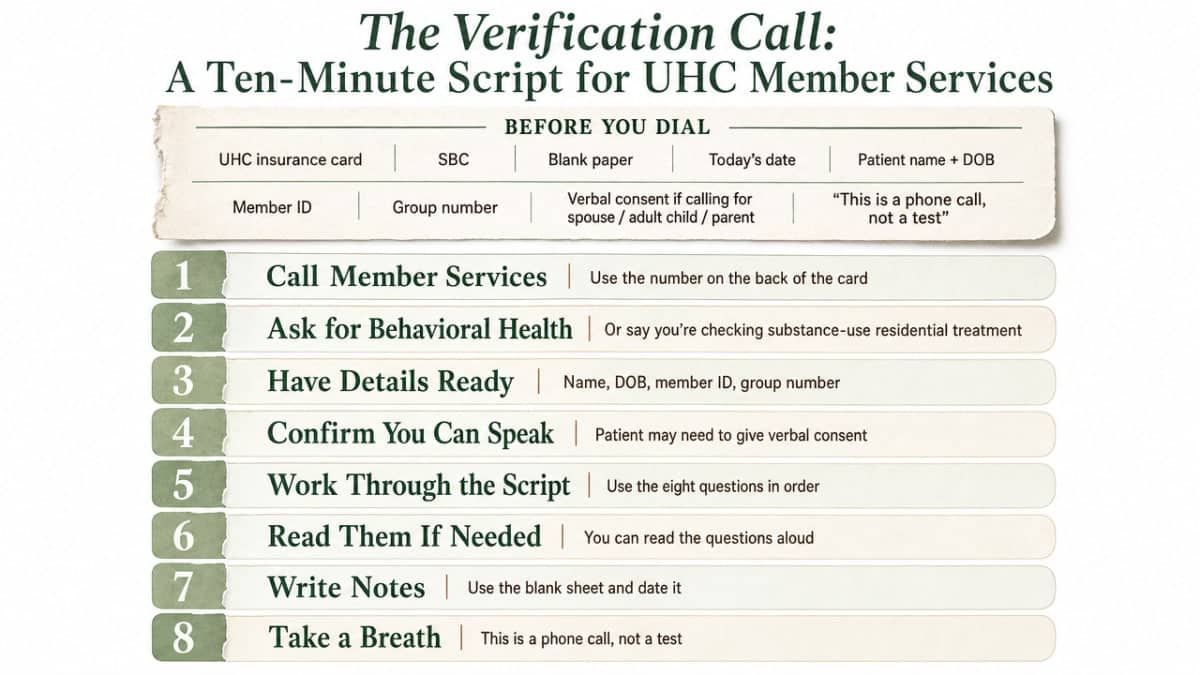
The Verification Call: A Ten-Minute Script for UHC Member Services
Before You Dial
Grab three things and put them on the table in front of you: your UHC insurance card, the SBC you just pulled, and a blank sheet of paper. Write today’s date at the top. Have the name and date of birth of the person who needs treatment ready, along with the member ID and group number from the front of the card. If you’re calling on behalf of a spouse, adult child, or parent, that person may need to be on the line briefly to give verbal consent for UHC to speak with you. Then take a breath. This is a phone call, not a test.
The Eight Questions to Ask
Call the member services number on the back of the card. Ask for the behavioral-health benefits line, or tell the representative you’re checking coverage for substance-use residential treatment. When someone picks up, work through these in order. Read them if you need to. There’s no prize for sounding casual.
1. “Does my plan include out-of-network behavioral-health benefits for residential substance-use treatment, and for medical detox?”2. “What is my out-of-network deductible for this plan year, and how much of it has already been met?”3. “After the deductible, what percentage does the plan pay for out-of-network residential SUD treatment, and what percentage is my responsibility?”4. “How does the plan calculate the allowed amount for an out-of-network residential facility — usual and customary, a Medicare-based rate, or something else?”5. “What is my out-of-pocket maximum for out-of-network care this plan year, and how much of it has already been met?”6. “Is prior authorization required for detox, residential, PHP, or IOP at an out-of-network facility? If yes, what is the process and who submits it?”7. “Does my plan cover medication-assisted treatment, and are there separate authorization or pharmacy rules?”8. “Can you give me a reference number for this call, and can I request the written medical necessity criteria you use for residential SUD care?”
Question eight matters more than it looks. Under federal parity rules, you have the right to that criteria 1, 2, and the DOL consumer guide confirms plans generally must provide the information used to decide medical necessity within about 30 days of a written request 3.
What to Write Down and Ask For in Writing
On your paper, capture the representative’s first name, the call reference number, the date and time, and every number they give you. Read the deductible, coinsurance, and out-of-pocket max back to them and ask, “Did I get that right?” Then say this: “Please send me a written summary of these benefits and the medical necessity criteria for residential SUD treatment.” A written record protects you if the answer changes later, and it’s the paper trail an appeal would rest on 3. You just did the hardest part. That page is your leverage.
Translating the Answers Into Real Dollars
The numbers you wrote down during the call don’t mean much on their own. Let’s turn them into a picture you can actually plan around.
Three numbers do most of the work: your out-of-network deductible, your coinsurance percentage, and your out-of-network out-of-pocket maximum. They stack in that order. First you pay the deductible. Then you and the plan split the next chunk of bills according to the coinsurance percentage. Then, once your spending hits the out-of-pocket maximum, the plan covers 100% of covered charges for the rest of the plan year.
Here’s a simplified scenario using placeholders, not real UHC numbers:
| Piece of the bill | What you pay ||—|—|| First $X of out-of-network care | 100% (your deductible) || Next portion, up to allowed amount | Your coinsurance % (often 30–50% out-of-network) || Anything above the plan’s “allowed amount” | Potentially 100%, unless negotiated || Once you hit your out-of-network max | $0 for the rest of the plan year |
That fourth row is the one people miss. Out-of-network reimbursement is often based on a “usual and customary” or Medicare-referenced rate, not the facility’s actual charge. The gap between those two numbers is called balance billing, and it’s why question four on your call script matters so much. Ask Elk Ridge’s admissions team what they’ve seen with plans like yours. They can’t promise a number, but they can give you a realistic range to plan against. That’s the difference between guessing and knowing.
Prior Authorization and Medical Necessity in Plain Language
Two phrases will come up over and over during your call, and they scare people more than they should. Let’s take the mystery out of them.
Prior authorization is your plan’s version of “ask before you go.” It means UnitedHealthcare wants a clinician to send them information about your situation and get an approval before your first day of treatment counts as covered. For residential care and detox, prior authorization is common. Under the 2024 parity rules, any authorization requirement for substance-use care has to be no stricter than what the plan uses for comparable medical care 2.
Medical necessity is the reason UHC either says yes or no. It’s a checklist of clinical facts: your substance use history, withdrawal risk, co-occurring mental health conditions, prior treatment attempts, and current safety. If those facts match the plan’s criteria for residential-level care, the request gets approved. You have a right to see that criteria in writing 1, 3.
The good news: Elk Ridge’s clinical team writes and submits these requests every week. You don’t fill anything out. You share your story once, at intake, and they translate it into the language UHC’s reviewers need.
If MAT Is Part of Your Care
If a clinician has recommended medication-assisted treatment, or you think it might be part of your plan, add one more layer to the verification call. MAT medications like buprenorphine, naltrexone, or methadone often sit under a different set of rules than the room-and-board portion of residential care. Private-insurance coverage for these medications varies by carrier, and prior authorization, cost-sharing, and limited prescriber networks can all get in the way 11.
Ask UHC three specific things: whether the medication is on your plan’s formulary, whether prior authorization is required, and whether it’s billed through your medical benefit or your pharmacy benefit. The answers change what you’ll pay and how quickly you can start. Elk Ridge’s clinical team can pursue authorization on your behalf, but knowing these answers up front prevents a gap between admission and your first dose.
Letting Elk Ridge’s Admissions Team Finish the Verification
Here’s the part most people don’t realize: after you make that ten-minute call, you can hand the rest off. You don’t have to become an insurance expert to get through admission. You just have to pass the baton.
When you’re ready, share four things with Elk Ridge’s admissions team: a photo of the front and back of your UHC card, the notes and reference number from your verification call, the SBC you pulled, and the name and date of birth of the person seeking treatment. From there, the admissions team runs a full verification of benefits directly with UnitedHealthcare, confirms the numbers you were given, initiates any prior authorization required for detox or residential care, and comes back to you with a plain-language summary of what your plan will likely pay and what your share is expected to be.
You already did the hard work. Making the call, pulling the document, writing the numbers down — that’s the part that took courage. Handing the paperwork off from here is allowed.
If the Answer Is Partial, Delayed, or No
Internal Appeal, External Review, and the Deadlines That Matter
A denial letter is not a closed door. It’s the start of a process your plan is legally required to give you access to, and the deadlines matter.
Read the denial notice the day it arrives. Two windows will shape what happens next. Under Department of Labor guidance, most plans give you about 180 days from the denial to file an internal appeal, and roughly four months after a final internal denial to request an independent external review 3. Miss those windows and you lose your strongest tools.
Before you file, request two things in writing: the specific medical necessity criteria used to make the decision, and the clinical rationale for the denial. Plans generally must provide this within 30 days of a written request 3. Under the 2024 parity rules, any authorization or network standard applied to your substance-use care must be no stricter than what the plan uses for comparable medical care 1, 2. That’s the argument your appeal rests on. Elk Ridge’s clinical team can draft the appeal with you.
Escalating in Montana
If the internal appeal comes back the wrong way, and you live in Montana, you have a local backstop. The Montana Commissioner of Securities and Insurance has consumer advocates who can help with appeals of denied health insurance claims. You can reach them at 800-332-6148 or 406-444-2040 13.
One caveat worth knowing before you call: state regulators oversee most insurance products, but some self-funded employer plans fall under federal ERISA rules instead 13. If your plan is self-funded, the Department of Labor’s Employee Benefits Security Administration is the right federal contact. Either way, you are not out of options after a first no.
When Coverage Is Partial: Braided Funding and Other Paths
Sometimes UnitedHealthcare approves part of what you need. Detox is covered, but residential is capped at a shorter stay. Or PHP is approved and IOP is not. This is more common than a flat denial, and it’s workable.
Residential substance-use programs are often financed through more than one source. SAMHSA notes that commercial-insurance benefits vary by plan and that programs may combine commercial coverage with Medicaid, grants, state funds, or self-pay when insurance is partial 9. Ask Elk Ridge’s admissions team about payment plans, sliding arrangements, and any state or scholarship resources they can point you toward. Partial coverage plus a plan for the gap is still a path in.
Speak With Admissions About Your Coverage Now
Get fast answers about your United Healthcare rehab coverage and next steps for starting treatment.
Frequently Asked Questions
Is Elk Ridge Recovery in-network with UnitedHealthcare?
No. Elk Ridge Recovery is not in-network with any insurance carrier, and that includes UnitedHealthcare. That doesn’t mean your plan won’t help pay. Many UHC plans, especially PPOs, include out-of-network behavioral-health benefits that can cover a real share of residential treatment. Verification tells you what your specific plan will do.
How do I find out if my UnitedHealthcare plan covers out-of-network residential rehab?
Start by pulling your Summary of Benefits and Coverage, which every plan must provide in plain language 5. Then call the member number on your card and ask whether your plan includes out-of-network residential SUD benefits, your deductible, coinsurance, out-of-pocket max, and prior authorization rules. Elk Ridge’s admissions team can finish the verification for you.
What out-of-pocket costs should I expect if my UHC plan pays part of the bill?
Three numbers shape your share: your out-of-network deductible, your coinsurance percentage, and your out-of-network out-of-pocket maximum. You pay the deductible first, then a percentage until you hit the max, then $0 for the rest of the plan year. Ask how UHC calculates the allowed amount, since charges above that can be billed to you.
Does UnitedHealthcare require prior authorization for residential treatment?
Often, yes. Prior authorization is common for detox and residential care, and under the 2024 parity rules any authorization requirement for SUD care must be no stricter than what the plan uses for comparable medical care 2. Ask directly during your verification call. Elk Ridge’s clinical team submits authorization requests on your behalf.
What can I do if UnitedHealthcare denies my claim or authorization?
You have roughly 180 days to file an internal appeal and about four months after a final internal denial to request external review 3. Request the medical necessity criteria and clinical rationale in writing. Montana residents can also contact the Commissioner of Securities and Insurance at 800-332-6148 for help with denied claims 13.
Can Elk Ridge’s admissions team verify my UHC benefits for me?
Yes. Send a photo of both sides of your UHC card, the member’s name and date of birth, and any notes from your own call. Admissions runs a full verification directly with UnitedHealthcare, initiates prior authorization when needed, and returns a plain-language summary of what your plan will likely pay and your estimated share.
References
- The Mental Health Parity and Addiction Equity Act (MHPAEA). https://www.cms.gov/marketplace/private-health-insurance/mental-health-parity-addiction-equity
- New Mental Health and Substance Use Disorder Parity Rules. https://www.dol.gov/agencies/ebsa/laws-and-regulations/laws/mental-health-parity/new-mhpaea-rules-what-they-mean-for-plans-and-issuers
- Understanding Your Mental Health and Substance Use Disorder Benefits. https://www.dol.gov/agencies/ebsa/about-ebsa/our-activities/resource-center/publications/understanding-your-mental-health-and-substance-use-disorder-benefits
- Mental health & substance abuse coverage. https://www.healthcare.gov/coverage/mental-health-substance-abuse-coverage/
- Summary of Benefits and Coverage. https://www.healthcare.gov/health-care-law-protections/summary-of-benefits-and-coverage/
- GAO-24-106794, BEHAVIORAL HEALTH. https://www.gao.gov/assets/gao-24-106794.pdf
- Medicare Advantage: CMS Oversight of Prior Authorization Criteria Should Target Behavioral Health Services. https://files.gao.gov/reports/GAO-25-107342/index.html
- Data on Substance Use and Mental Health Treatment Facilities: 2024 National Substance Use and Mental Health Services Survey Annual Report. https://www.samhsa.gov/data/sites/default/files/reports/rpt56696/2024-nsumhss-annual-report.pdf
- Examining the Use of Braided Funding for Substance Use Disorder Services. https://library.samhsa.gov/sites/default/files/cfri-braided-funding-report-pep23-06-07-002.pdf
- The U.S. Behavioral Health Care System. https://www.ncbi.nlm.nih.gov/books/NBK609446/
- US payment policy for medications to treat opioid use disorder. https://pmc.ncbi.nlm.nih.gov/articles/PMC10986242/
- Changes in Access to Substance Use Disorder Treatment Following Mental Health Parity Implementation. https://pmc.ncbi.nlm.nih.gov/articles/PMC13137754/
- File a Complaint. https://csimt.gov/insurance-complaints-fraud/