Key Takeaways
- Historical, intergenerational, and lived trauma are distinct layers that show up differently in the body and life, and effective treatment has to address whichever threads are pulling hardest without ignoring the others.
- Research shows trauma raises the odds of substance use but does not determine the outcome, and reflective awareness of historical trauma is linked to more abstinent days while unprocessed symptoms track with fewer 2.
- The current overdose landscape demands screening beyond alcohol, since 59% of overdose deaths among AI/AN people involved stimulants and 43.1% involved both stimulants and opioids 9.
- When evaluating a program, distinguish trauma-informed, culturally adapted, and culturally grounded care, and ask concrete questions about assessment, medication-assisted treatment, peer staffing, ceremony, and aftercare handoffs.
What You’re Carrying Is Real, And It Isn’t the Whole Story
If you’re reading this while still using, or between relapses, or between the small honest promises you keep making to yourself at 3 a.m., start here: what you’re carrying is real. The grief in your family that never got named. The relatives who went to boarding school and came home different, or didn’t come home at all. The friends you’ve already buried. The way the news, the clinic waiting room, and the checkout line can each carry a small sting you’re supposed to shake off. None of that is imagined. Researchers have measured it, and federal agencies define historical trauma as the cumulative effects of large-scale group trauma experienced by AI/AN peoples since colonization 6.
And here’s the part most articles skip. That history is one strand in your story. It isn’t the verdict.
This piece won’t romanticize any of it, and it won’t reduce you to a risk profile. You’ll get honest language for three different kinds of trauma, the current evidence on how they connect to substance use, and a straight look at what culturally respectful, trauma-informed treatment should actually do when you walk through the door. You already know addiction from the inside. You deserve information that meets you there.
Three Kinds of Trauma, Named Plainly
Historical, Intergenerational, and Lived Trauma Are Not the Same Thing
People use the word trauma like it’s one thing. It isn’t. When you’re trying to make sense of your own using, it helps to sort out at least three different layers, because they show up in your body and your life in different ways.
Historical trauma is the collective one. Federal health agencies define it as the cumulative effects of large-scale group trauma experienced by AI/AN peoples and nations since colonization 6. Boarding schools. Forced removal from land. Bans on ceremony and language. Epidemics. The point isn’t the list. The point is that a whole people carried loss at a scale that outlived any single generation.
Intergenerational trauma is how some of that gets passed down. Not mystically. Through the ways your parents were parented, through what got said and what stayed silent at the kitchen table, through a grandmother who came back from school unable to hold you the way she wanted to. Researchers have measured it through things like historical-loss thinking and residential-school ancestry 5.
Lived trauma is what happened to you. Childhood abuse. A car wreck. A partner who hurt you. Being followed in a store. A cousin’s funeral last spring. In one review of 42 studies with AI/AN adults, lifetime trauma exposure ran anywhere from 21% to 98% depending on the sample, and it tracked with higher rates of substance-use disorders 4.
Three layers. Overlapping, but not identical.
Why the Distinction Changes What Treatment Should Do
Sorting these three apart isn’t an academic exercise. It changes what a clinician should actually do with you in the room.
If most of what you’re carrying is lived trauma, you need evidence-based trauma treatment that goes at the memory and the nervous system directly. If intergenerational patterns are driving how you cope, family and relational work matters more than another worksheet. If historical trauma is loud for you, cultural connection, community, and space to grieve losses that were never yours alone belong in the plan, not as decoration.
Most people carry some of all three. That’s normal, and it’s why the research keeps landing on the same practical point: substance use, mental health, and trauma need to be treated together, not in separate silos with separate waiting lists 7. A program that only treats the drinking, or only treats the PTSD, or only nods at culture in a Friday afternoon group is going to miss where your using actually lives.
The clinical question isn’t which trauma is real. All three can be. The question is which threads are pulling hardest on you right now, and whether the people helping you can hold all of them at once.
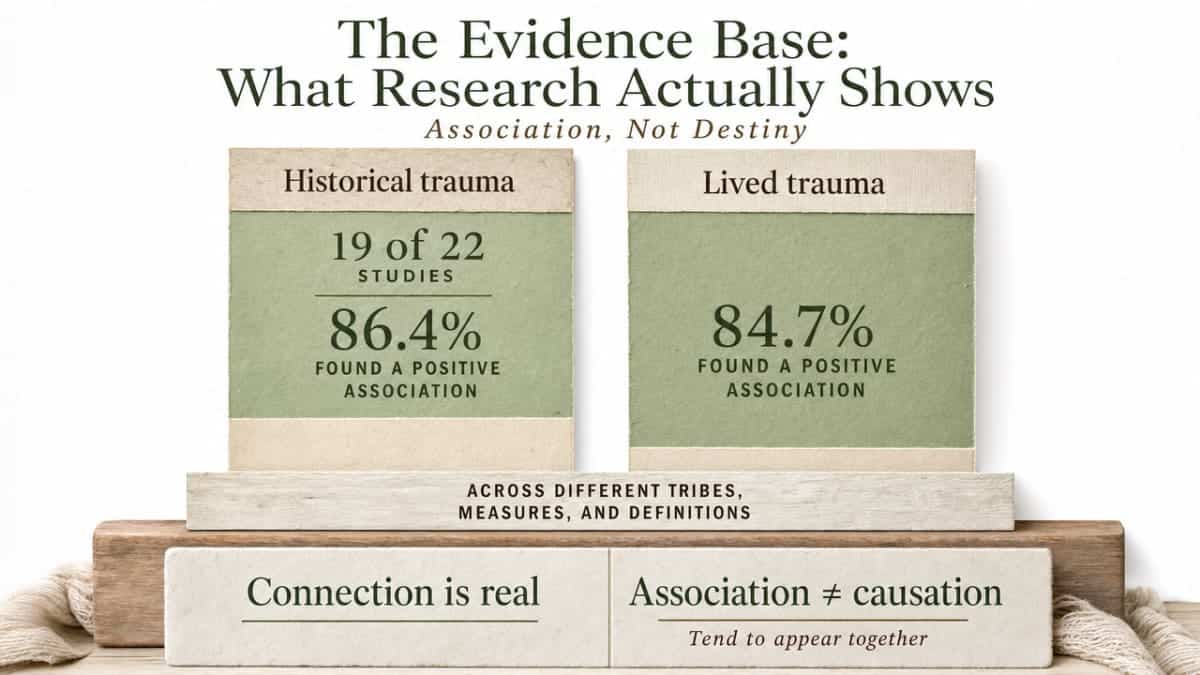
The Evidence Base: What Research Actually Shows
Association, Not Destiny
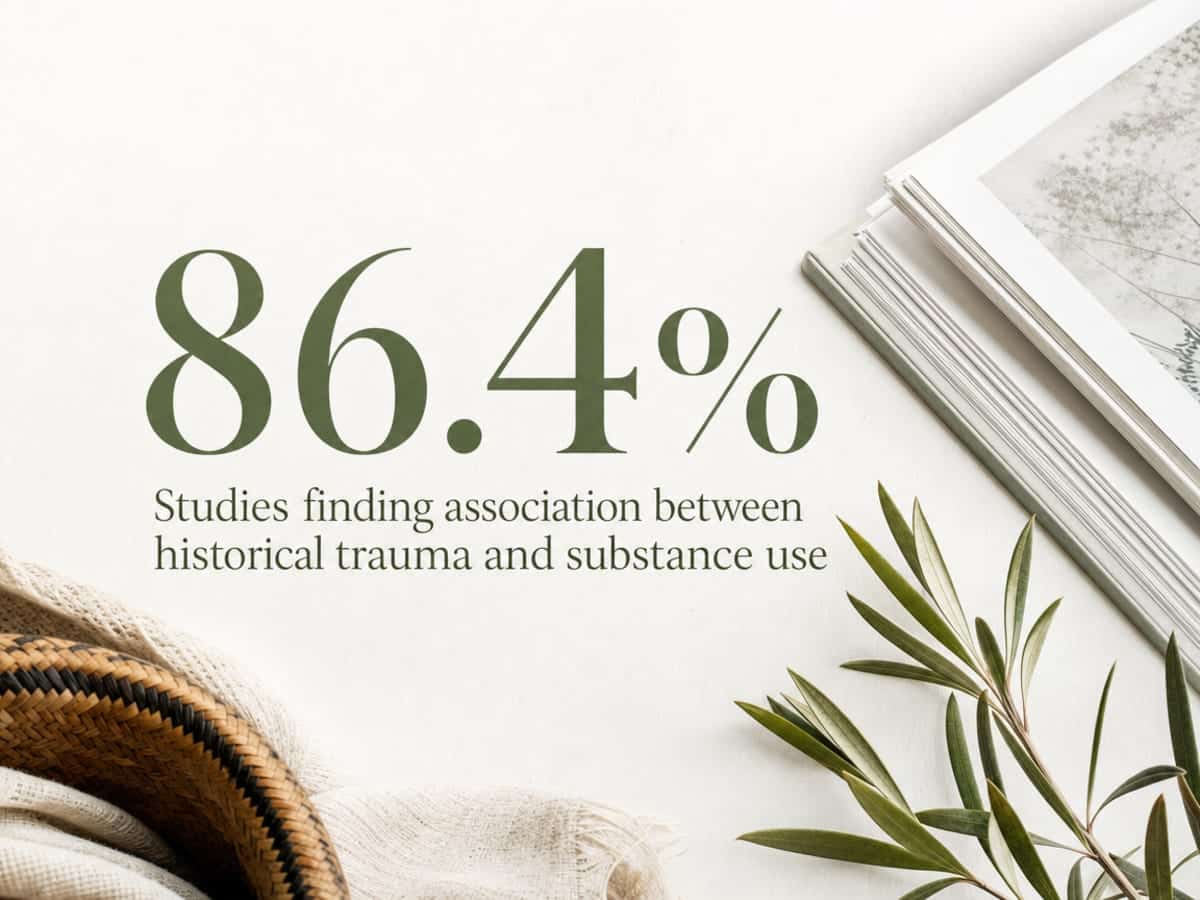
Here’s what the research actually says, in plain terms. When investigators pooled the studies on trauma and substance use among Indigenous peoples in the United States and Canada, the pattern was hard to miss. Out of 22 studies looking at historical trauma, 19 (86.4%) found a positive association with substance use. For lived trauma, 84.7% of studies found the same kind of link 1. That is a lot of independent research groups, working with different tribes, different measures, and different definitions, landing in roughly the same place.
So yes, the connection is real. It is not something someone made up to explain your using.
But read that sentence again: positive association. That is a statistician’s phrase, and it matters. Association means two things tend to show up together. It does not mean one causes the other in a straight line, and it does not mean everyone who carries historical or lived trauma will develop a substance-use disorder. The same review is careful about this. The studies varied in design, in how they defined historical trauma, and in who they included 1. Some measured historical-loss thinking. Some measured residential-school ancestry. Some measured symptoms. They are not all asking the same question.
What that means for you, sitting with your own story: the odds shift, they don’t lock. Trauma raises risk. It does not sign your name to a life sentence. Plenty of people carrying the same collective and personal weight you carry never develop a substance-use problem, and plenty who do get free of it. The evidence supports taking trauma seriously in your treatment plan. It does not support treating you like the outcome is already decided.
The Counterintuitive Finding About Thoughts vs. Symptoms
There is one finding in this literature that most articles about Native people and addiction quietly skip, probably because it complicates a simpler story. It is worth your time.
Researchers studying American Indian adults with current substance-use problems separated two different things: thoughts about historical trauma (reflective awareness — thinking about what your people have been through, what was lost, what got passed down) and symptoms of historical trauma (distress, anger, hypervigilance, grief that pulls you under). Then they looked at drinking and drug-use days.
What they found flipped the usual assumption. Historical-trauma thoughts were associated with more abstinent days and fewer heavy-drinking and drug-use days. Historical-trauma symptoms were associated with fewer abstinent days 2. Awareness and distress were not the same variable, and they did not move in the same direction.
What the Current Numbers Show, Without the 2015 Reruns
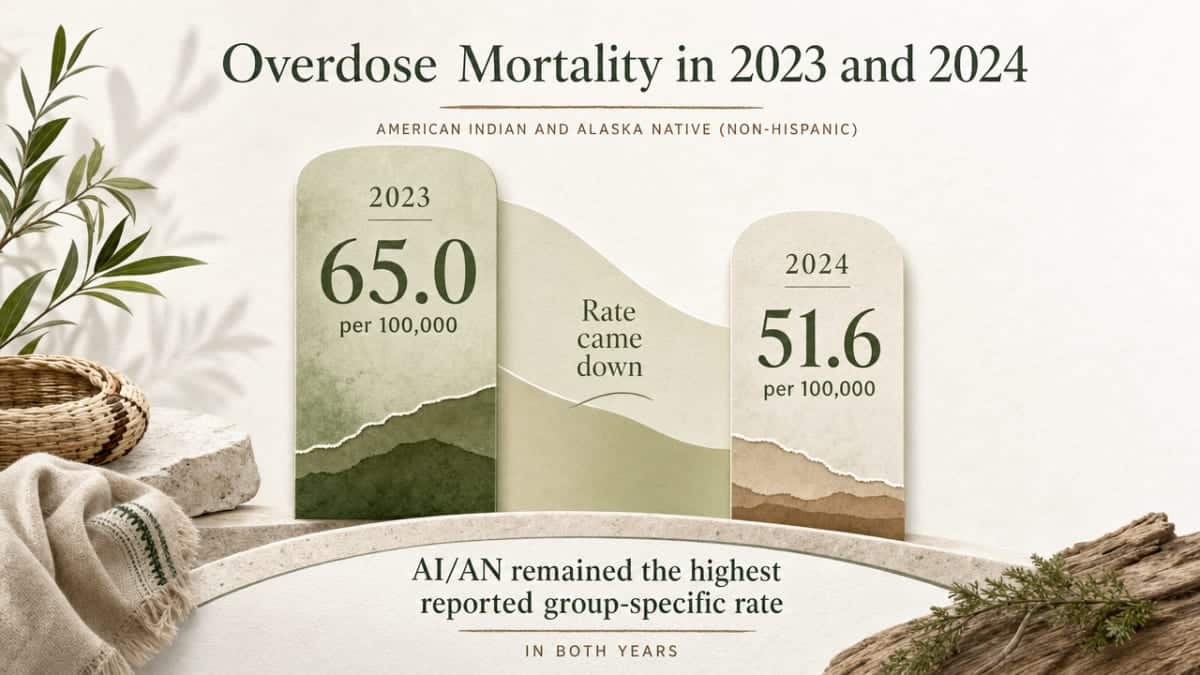
Overdose Mortality in 2023 and 2024
A lot of what gets written about Native people and addiction still leans on statistics from a decade ago. Those numbers made a point in their moment. They are not the point now. The drug supply changed. The pandemic changed the ground under everyone. What is happening in 2023 and 2024 is different, and if you are trying to decide what treatment to pursue, you deserve to see the current picture.
Here is what the CDC reported. The age-adjusted overdose death rate for American Indian and Alaska Native (non-Hispanic) people was 65.0 per 100,000 in 2023 and 51.6 per 100,000 in 2024 8. Two things to notice at once. The rate came down between those years, which is real and worth naming. And AI/AN remained the highest reported group-specific rate in the country in both years 8.
One quick translation, because the phrase gets thrown around: age-adjusted just means the rate has been math-adjusted so populations with different age structures can be compared fairly. It is not a measure of anything about you personally. It is a way to compare communities without one looking worse or better only because it happens to have more young or old people.
What that mortality picture means, sitting with your own risk: the environment you are using in right now is more dangerous than the one your older cousins used in. That is not a scare tactic. It is a reason to move sooner rather than later, and to expect any program you enter to take overdose seriously from day one.
Stimulants, Fentanyl, and Why Screening Can’t Stop at Alcohol
If a treatment program only asks about your drinking, walk out. The drug landscape shifted years ago, and the assessment has to catch up.
Look at stimulants first. Among non-Hispanic AI/AN people, the psychostimulant-involved overdose death rate climbed from 11.0 per 100,000 in 2018 to 32.9 in 2023 9. That is roughly a tripling in five years. Across the same reporting window, 59% of overdose deaths among AI/AN people involved stimulants, and 43.1% involved both stimulants and opioids 9. Meth. Cocaine. Often mixed with fentanyl, whether you knew it was in there or not.
Fentanyl in the nonfatal picture is moving too. Suspected fentanyl-involved overdose emergency department visits among AI/AN people rose an average of 9% per quarter from October 2020 through March 2024, the largest quarterly increase of any group the CDC reported 10. Every one of those visits is someone who came close and made it back. Every one is also a moment where naloxone, honest screening, and a warm handoff to treatment could change what happens next.
What this changes for you in practical terms: the intake conversation at any program worth your time should cover alcohol, opioids, stimulants, benzodiazepines, and what has actually been showing up in your supply. Not a checklist read at you. A real conversation. It should include overdose education, naloxone in your hands (and in your family’s hands) before you leave, and a medication-assisted treatment discussion if opioids are part of your story. If a place cannot talk fluently about polysubstance use and fentanyl contamination in 2024, it is not equipped for the risk you are actually walking in with. Screening that stops at alcohol misses most of what is killing your neighbors.
Risk and Protection Live Side by Side
What Raises Risk, What Buffers It
If you only ever heard the risk side of this conversation, you would be forgiven for thinking recovery was a coin flip weighted against you. It isn’t. The research on trauma and substance use among AI/AN adults consistently maps both sides of the ledger, and any honest treatment plan works with both.
On the risk side, the same review of 42 studies keeps naming a familiar set of threads:
- early-life trauma
- later interpersonal trauma
- boarding-school experiences in your family line
- discrimination that lands on you now
- the ache researchers call historical loss — thinking about the language, land, and relatives that got taken 4
Those aren’t ranked in some tidy order. They compound. A kid who grew up around a parent who came home from school unable to be soft, who then got hurt as a teenager, who then gets followed around a store as an adult — that’s not five separate weather systems. It’s one climate.
On the protective side, the same body of work keeps surfacing a different set: cultural identity, traditional practice, community connection, and care that treats you with respect instead of suspicion 4. Federal guidance says the same thing in plainer language — community- and culture-based interventions are especially important for AI/AN behavioral health, not as decoration, but as clinical mechanism 6.
Here is what that means for the plan you actually build. Assessment should ask about all of it. Not just how many drinks per week and when you first used. Also: what happened to you as a kid, what you’ve lived through since, what you know about your family’s history with boarding schools or removal, how discrimination lands on you now, and — just as importantly — what has kept you alive so far. Who you belong to. What practices, if any, still steady you. What language, songs, food, or land you count as yours. Programs that only chart the risk side end up treating you like a diagnosis. Programs that chart both sides can actually help you build something.
Cultural Identity as a Clinical Asset, Not a Wound to Avoid
A lot of clinicians, even well-meaning ones, treat Native identity like a bruise to work around. Don’t press too hard. Don’t ask too much. Stick to the drinking. That instinct comes from a real place — no one wants to cause harm — but the evidence points somewhere else.
Ethnic identity keeps showing up in this research as a moderator, meaning it changes how other things land. In the same study that separated historical-trauma thoughts from symptoms, stronger ethnic identity was part of what shaped substance-use outcomes for the better 2. State practice guidance for peer support in Native communities says something similar in different words: culture-based interventions and culturally adapted evidence-based practices tend to outperform unadapted dominant-culture approaches alone, and peers are trained to validate the effects of historical trauma rather than tiptoe around them 15.
Read that plainly. Your identity is not the thing your provider needs to protect you from. It is one of the resources they should be helping you draw on. If a program treats being Native as a footnote, or as a fragile topic they’d rather leave alone, that is a signal about the program, not about you.
What Trauma-Informed, Culturally Respectful Care Looks Like in Practice
Trauma-Informed vs. Culturally Adapted vs. Culturally Grounded
These three phrases get used like they mean the same thing. They don’t. Sorting them out gives you a real tool for evaluating any program that says it serves Native clients well.
- Trauma-informed
- The baseline. It means the staff assumes most people walking in have a trauma history, and they build the whole environment around not making things worse. Intake doesn’t feel like an interrogation. Restraints and isolation aren’t first-line responses. You get told what’s happening before it happens. Trauma-informed is a floor, not a ceiling, and any decent program in 2024 should already be there.
- Culturally adapted
- An evidence-based treatment was modified for Native clients. Two of the most-studied examples are Trauma-Focused Cognitive Behavioral Therapy and Seeking Safety, both of which have documented cultural adaptations in the Native-community literature 12. Adaptation isn’t a coat of paint. A useful review defines the work as changing language, delivery, context, community participation, and how cultural strengths get built in — not just adding a graphic to a worksheet 3.
- Culturally grounded
- The program itself was built by and with a specific Native community, from the ground up, using that community’s practices as the actual treatment mechanism. Wellbriety is one example. Tribally operated healing programs are another. A review of Indigenous-focused residential treatment found that all 35 sources it examined used cultural methods as part of dual treatment for trauma and substance use 13.
Most programs live somewhere on this ladder. Knowing which rung matters. A trauma-informed program can serve you well without being culturally grounded. A program that claims to be culturally grounded without community roots is selling something.
Questions Worth Asking a Provider Before You Commit
Before you sign anything, ask. A good program will answer plainly. A defensive one tells you something too.
Try these, in whatever order feels right:
- What does your intake assessment ask about early-life trauma, family history with boarding schools or removal, discrimination, and historical loss — not just substance use?
- Which evidence-based trauma treatments do you use, and have any of them been culturally adapted? (TF-CBT and Seeking Safety are the two with the strongest published adaptation records 12.)
- How do you handle polysubstance use and fentanyl contamination? Do I leave with naloxone in my hand and my family’s?
- Do you offer medication-assisted treatment if opioids are part of my story?
- How is mental health treated alongside substance use, not in a separate silo 7?
- What role do peers with lived recovery experience play, and are any of them Native?
- If I want to bring in cultural practice — smudging, ceremony, contact with a spiritual advisor from home — how does that actually work here?
- What does the handoff to outpatient, aftercare, or my home community look like on day 31?
You’re not being difficult by asking. You’re doing the assessment they should already be doing on themselves. If the answers are vague, or if someone gets irritated that you asked, that’s data.
Where Elk Ridge Fits, and Where It Doesn’t
Straight answer, because you deserve one. Elk Ridge Recovery is a Montana-based residential provider offering a full continuum of care — medical detox, residential inpatient, partial hospitalization, intensive outpatient, standard outpatient, and aftercare — for adults with substance-use disorders, including dual-diagnosis support for co-occurring mental-health conditions. The program serves clients from Montana, Idaho, North Dakota, South Dakota, and Wyoming, a region where many people walking through the door are Native.
Here is what Elk Ridge is: trauma-informed, JCAHO-accredited, staffed by a team that includes people with lived recovery experience, and equipped to work with cultural practices like smudging and Wellbriety alongside evidence-based clinical care. Peer support, family therapy, medication-assisted treatment, and case management are part of the standard offering, not add-ons.
Here is what Elk Ridge is not: a tribally owned or tribally operated program. It doesn’t claim to be the same thing as a healing lodge rooted in your specific Nation, and it can’t replace the ceremony, kinship, and homeland that only your own community holds. What it can do is hold your whole story in the room — ancestry, family, grief, and using — without flattening any of it, and support the person in front of it, one plan at a time 15.
Speak With Someone Who Understands Trauma Recovery
Connect with a caring professional who listens and helps you take the next step toward healing from trauma.
Frequently Asked Questions
Does historical trauma cause addiction in Native people?
No. The relationship is an association, not a straight causal line. The research consistently links historical and lived trauma to higher substance-use risk in Indigenous populations, but plenty of people who carry that weight never develop a substance-use disorder, and plenty who do get free of it 1, 5. Trauma shifts the odds. It doesn’t decide your outcome.
What is the difference between historical, intergenerational, and lived trauma?
Historical trauma is the cumulative group harm carried by AI/AN peoples since colonization — boarding schools, forced removal, cultural suppression 6. Intergenerational trauma is how those wounds get passed down through families, parenting, and silence. Lived trauma is what happened to you personally: childhood harm, assault, loss, discrimination 4. Most people carry pieces of all three.
What should I look for in a treatment program that says it’s culturally respectful?
Ask what they actually change, not what they call it. A useful review defines meaningful cultural tailoring as adapting language, delivery, context, community participation, and how cultural strengths get built into the treatment itself — not adding a graphic to a worksheet 3. Ask which evidence-based trauma treatments they’ve adapted, whether Native peers are on staff, and how they welcome ceremony or spiritual advisors from your home community.
Is Elk Ridge Recovery a tribal treatment program?
No. Elk Ridge is a Montana-based, JCAHO-accredited residential provider serving adults across Montana, Idaho, North Dakota, South Dakota, and Wyoming. It is trauma-informed and works with cultural practices like smudging and Wellbriety alongside evidence-based clinical care, but it is not tribally owned or tribally operated. It can hold your whole story — it can’t replace what your own Nation holds.
Can talking about historical trauma in treatment make substance use worse?
The research points the other direction, with an important distinction. In a study of American Indian adults with substance-use problems, reflective thoughts about historical trauma were associated with more abstinent days, while unprocessed trauma symptoms — the distress, the grief, the hypervigilance — were associated with fewer abstinent days 2. Awareness held in a good clinical container tends to help. Unaddressed pain doesn’t.
Why does treatment need to screen for stimulants and fentanyl, not just alcohol?
Because the supply changed. Across a recent CDC reporting window, 59% of overdose deaths among non-Hispanic AI/AN people involved stimulants, and 43.1% involved both stimulants and opioids 9. A program that only asks about drinking misses most of the risk you’re actually carrying. Real intake covers alcohol, opioids, stimulants, benzodiazepines, and what’s been in your supply lately.
References
- Trauma and Substance Use among Indigenous Peoples of the United States and Canada: A Systematic Review. https://pmc.ncbi.nlm.nih.gov/articles/PMC12109140/
- Historical Trauma and Substance Use among American Indian People with Current Substance Use Problems. https://pmc.ncbi.nlm.nih.gov/articles/PMC8084991/
- Culturally Tailored Substance Use Interventions for Indigenous People of North America: A Systematic Review. https://pmc.ncbi.nlm.nih.gov/articles/PMC10248734/
- A Systematic Review of Trauma and Substance Use in American Indian and Alaska Native Individuals: Incorporating Cultural Considerations. https://pmc.ncbi.nlm.nih.gov/articles/PMC9329482/
- The Impact of Historical Trauma on Health Outcomes for Indigenous Populations in the USA and Canada: A Systematic Review. https://pubmed.ncbi.nlm.nih.gov/30652897/
- American Indian/Alaska Native Behavioral Health Briefing Book. https://www.ihs.gov/sites/dbh/themes/responsive2017/display_objects/documents/AIANBHBriefingBook.pdf
- Behavioral Health | Fact Sheets – Indian Health Service. https://www.ihs.gov/newsroom/factsheets/behavioralhealth/
- Drug Overdose Deaths in the United States, 2023–2024. https://www.cdc.gov/nchs/products/databriefs/db549.htm
- Drug Overdose Deaths Involving Stimulants — United States, January 2018–June 2024. https://www.cdc.gov/mmwr/volumes/74/wr/mm7432a1.htm
- Trends in Suspected Fentanyl-Involved Nonfatal Overdose Emergency Department Visits — United States, October 2020–March 2024. https://www.cdc.gov/mmwr/volumes/74/wr/mm7416a2.htm
- Substance Use Disorder in the Past Year: 2022–2024 National Survey on Drug Use and Health. https://www.samhsa.gov/data/sites/default/files/reports/rpt56619/2024-nsduh-psr3-sud.pdf
- Trauma Interventions. https://pmc.ncbi.nlm.nih.gov/articles/PMC7243818/
- Addressing Experiences of Trauma within Indigenous-Focused Substance Use Residential Treatment: A Systematic Review and Environmental Scan. https://pubmed.ncbi.nlm.nih.gov/38146766/
- A Scoping Review of American Indian and Alaska Native Representation in the National Institute on Drug Abuse Clinical Trials Network. https://pmc.ncbi.nlm.nih.gov/articles/PMC10529616/
- Native American SUD Peer Best Practices. https://www.oregon.gov/oha/HSD/AMH-PD/Documents/NA-SUD-Peer-Best-Practices.pdf