Key Takeaways
- Montana licenses rehab facilities in four categories — outpatient, inpatient, residential, and partial hospitalization — and state approval to bill Medicaid sits separately from independent accreditation like Joint Commission or CARF.
- Match the person to an ASAM level rather than a brand, and confirm the facility can start and continue buprenorphine, methadone, or naltrexone rather than stopping treatment at detox 3.
- With 50 of 56 Montana counties designated mental-health shortage areas 1, press for specifics on overnight staffing, therapist caseloads, prior authorization handling under 2025 Medicaid rules 10, and where the outpatient handoff lands near home.
- Before signing anything, use the intake scripts to confirm license type, ASAM level recommended, staffing coverage, the first post-discharge appointment, and who submits prior authorization if the payer denies the recommended level.
What actually separates one Montana rehab from another
If you’re reading this at 2 a.m. with a browser full of open tabs, that already took courage. Most Montana rehab websites look the same on the surface — mountain photos, words like “compassionate” and “evidence-based,” a phone number that promises someone will answer. The real differences sit underneath that marketing layer, and they come down to four things you can actually verify before you ever sign a consent form.
The four verifiable differentiators:
- The facility holds a current Montana state license for the specific level of care it advertises, and ideally carries independent accreditation on top of that 5, 7.
- It has enough clinical and medical staff on site to safely run that level of care, in a state where 50 of 56 counties carry a mental-health provider shortage designation 1.
- It offers a real continuum — detox, residential, PHP, IOP, outpatient, aftercare — with warm handoffs between each step, not just a discharge letter 2.
- The location fits your medical needs, your family’s driving reality, and your insurance.
This guide gives you the questions to ask and what the answers should sound like. Keep it open on your phone during the intake call.
Start with the license: what Montana actually approves
The four facility types Montana licenses
Before you compare amenities or read a single testimonial, find out what the state has actually signed off on. Montana licenses substance-use-disorder facilities in exactly four categories: outpatient, inpatient, residential, and partial hospitalization 5. That’s it. If a website uses phrases like “detox retreat” or “recovery lodge” without naming one of those four categories, you have a fair question to ask: which license do you hold, and what level of care does it authorize?
The distinction matters more than it sounds. Each license type carries different building, staffing, and clinical requirements tied to the ASAM Criteria 6. A residential license does not automatically mean a facility can medically manage withdrawal. An outpatient license does not mean the program can house someone overnight. If your loved one needs supervised detox and the facility is licensed only for residential care without a withdrawal-management designation, that is a mismatch you want to catch on the intake call, not on day two.
Ask directly: “What is your Montana license type, and what ASAM levels of care does it cover?” A confident intake coordinator will answer without hedging. Anything vaguer than that is a signal.
License first, state approval second, accreditation on top
There’s a sequence here that many families don’t know exists. In Montana, a facility must obtain its license before it can apply for state approval to bill Medicaid and follow the state’s ASAM-aligned service manual 7. First-time applicants can operate under a six-month provisional license while the full process finishes 5. Provisional is not disqualifying, but it is worth knowing about, especially if the program opened recently.
Think of it as three layers:
- The state license is the legal floor — the facility is allowed to operate.
- State approval means it can accept Montana Medicaid and has agreed to follow ASAM Criteria in how it delivers care 7.
- Independent accreditation from a body like The Joint Commission or CARF sits on top; it’s voluntary, it costs the facility real money to maintain, and it signals ongoing outside review of policies, safety, and clinical practice.
On the phone, this is a two-question check. Ask: “Are you currently licensed by Montana DPHHS, and are you state-approved to bill Medicaid?” Then: “Do you hold any independent accreditation, and when was your most recent survey?” You are looking for specific names and dates, not adjectives.
Match the level of care to the person on the couch
ASAM levels translated into plain English
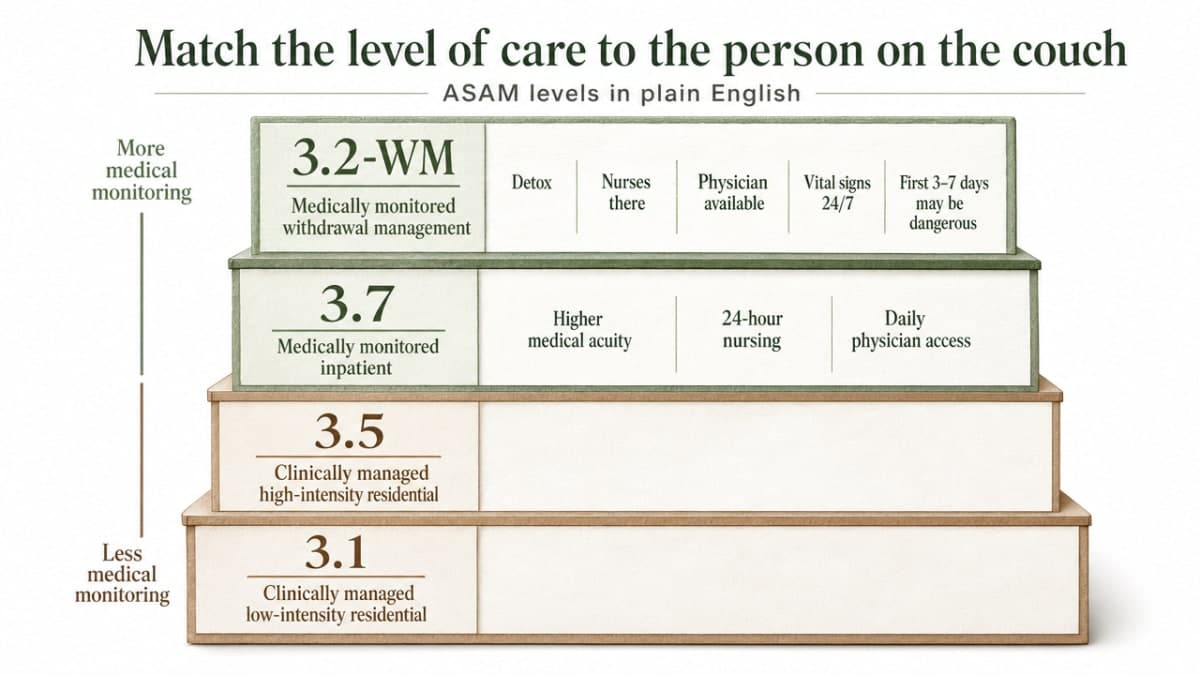
The letters and numbers you’ll hear on the phone — ASAM 3.1, 3.5, 3.7, 3.2-WM — are not marketing. They are the American Society of Addiction Medicine’s levels of care, and Montana’s facility rules are built directly on top of them 6. Once you can read the ladder, you can tell whether a facility is offering what your person actually needs.
Here is the ladder in plain English.
- 3.2-WM — Medically monitored withdrawal management
- What most people call detox. Nurses are there. A physician is available. Vital signs get checked around the clock. This is where someone goes when the first 3 to 7 days could be dangerous without medical eyes.
- 3.7 — Medically monitored inpatient treatment
- Higher medical acuity, 24-hour nursing, and daily physician access — the right fit when someone has a serious co-occurring medical or psychiatric condition alongside the addiction.
- 3.5 — Clinically managed high-intensity residential
- This is the classic “residential rehab” most families picture: structured programming most of the day, group and individual therapy, medical staff on call, a bed for 30 to 90 days.
- 3.1 — Clinically managed low-intensity residential
- Still a bed, still structure, but fewer clinical hours per week — often a step-down after 3.5 or a starting point for someone with a more stable medical picture.
Ask the intake coordinator: “Which ASAM levels are you licensed to provide, and which level are you recommending for this person, based on what?” You want a specific number and a specific reason, not “we tailor it to each client.”
Why ‘detox only’ is not a plan
What you want to hear on the phone is a plan that connects detox to what comes next before anyone unpacks a bag. That means on-site medical staff who can start buprenorphine, methadone, or naltrexone when it’s clinically appropriate, and a residential or outpatient step that keeps that medication going 3. It means the intake coordinator can describe, without stumbling, how someone moves from a 3.2-WM detox bed to a 3.5 residential bed to a PHP or IOP schedule — inside the same organization or through a specific partner they’ve worked with before.
Ask: “If detox goes well, what does day 8 look like here? Day 30? Day 60?” If the answer is “we’ll figure it out then,” keep calling other places. Recovery is not a one-week event, and the facility you choose should already be thinking three months ahead of where your person is right now.
Ask about staffing the way a nurse would
Staffing is where a lot of Montana rehab websites get vague, and it’s where you need the most specifics. The state’s workforce math is against you before you dial the first number. In a 2024 behavioral-health needs assessment, 70.92% of Montana respondents named the shortage of mental-health professionals as the single greatest barrier to care, ahead of distance, affordability, evening and weekend availability, and continuity of care 8. That does not mean any one facility is understaffed. It means you cannot assume otherwise, and you have every right to ask.
Ask like a nurse would ask, not like a website visitor. Who is on the unit at 3 a.m. on a Saturday? A nurse? A tech? How many clients per staff member overnight versus during programming hours? Who is the medical director, are they on site or on call, and how fast can they get there if something changes with a detox patient? Is there a psychiatrist or psychiatric nurse practitioner who can adjust medications during your stay, or does that require an outside referral?
Then ask about the clinical team the same way. What licenses do the primary therapists hold — LCSW, LCPC, LAC? What is the caseload per therapist? How many individual sessions per week are built into the schedule, not just group? Does the program have staff trained in co-occurring mental health conditions, since most people entering residential care are carrying more than one diagnosis?
AHRQ’s behavioral-health quality framework gives you a few more angles worth pressing on:
- Timely access to care
- How clinicians communicate
- Whether medication side effects are explained clearly
- Family involvement
- Cultural competency 4
A facility that measures itself on those domains will not stumble when you ask how they measure them.
One last question separates prepared programs from unprepared ones: what is the backup plan when a key staff member is out? In a state where shortage designations describe entire regions 9, the answer should be a specific person or a specific coverage arrangement, not silence.
Follow the continuum from detox to the first Tuesday home
A good rehab is not a place. It is a chain of handoffs, and the chain is only as strong as its weakest link. The moment that matters most is not admission day. It is the first Tuesday your person is home, alone, at 4 p.m., when the structure disappears and the cravings do not.
Ask the intake coordinator to walk you through the whole chain, step by step, in one breath:
- Detox to residential.
- Residential to partial hospitalization.
- PHP to intensive outpatient.
- IOP to standard outpatient.
- Standard outpatient to an aftercare or alumni program that keeps a real hand on the shoulder.
If any of those links live outside the facility, ask who the partner is by name, how often they refer there, and what the handoff actually looks like.
Research on SUD care transitions is clear about what works: warm handoffs where a clinician introduces the next provider, scheduled follow-up appointments booked before discharge, bridge medication so no one runs out between prescribers, peer navigation, and transportation planning 2. Two outcomes are worth tracking — did the person attend any post-discharge visit, and how long did they stay engaged in care after they left 2. Ask the facility how they measure both.
Then ask the smaller questions that reveal whether the chain is real:
- Who books the first outpatient appointment, the client or a case manager?
- Is the appointment on the calendar before the client gets in the car to leave?
- If your person is on buprenorphine, methadone, or naltrexone, who writes the next prescription, and is there a written bridge until that clinician takes over 3?
- Does the alumni program actually call, or is it a monthly email?
If the answers get vague after residential, the chain breaks where it matters most. Keep looking.
Location, distance, and the two-hour drive on Highway 2
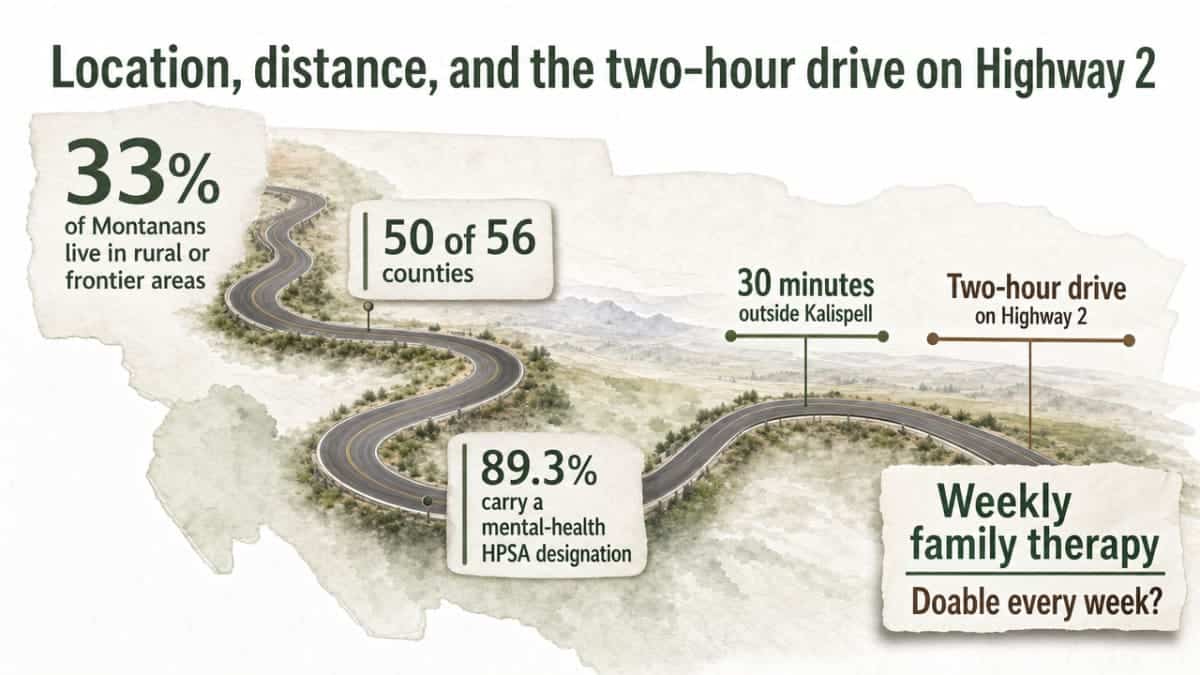
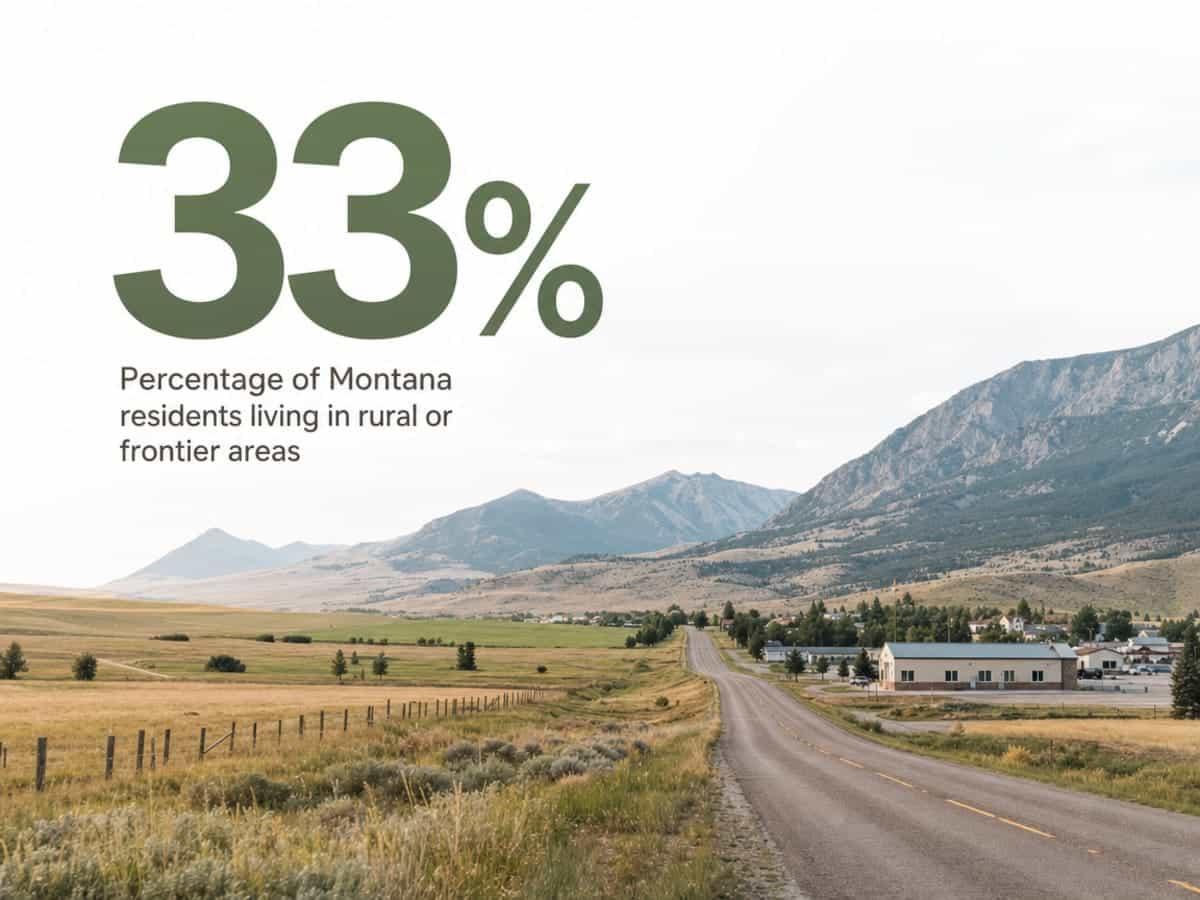
Geography does more work in Montana than in almost any other state, and it will quietly shape whether the rehab you pick actually works. About 33% of Montanans live in rural or frontier areas, and 50 of 56 counties — roughly 89.3% — carry a mental-health Health Professional Shortage Area designation 1. That is not a talking point. That is the driving map behind every decision you’re about to make.
Start with the honest question: how far is too far? A facility 30 minutes outside Kalispell feels close on paper. A facility that requires a two-hour drive on Highway 2 in February, with a spouse who works swing shifts and two kids in school, will not sustain weekly family therapy. If the program builds family sessions into the treatment plan, the drive has to be doable every week, not just on admission day. Ask the intake coordinator what percentage of families actually make it to family programming, and what they do for families who can’t — secure video sessions, weekend intensives, mailed workbooks that a therapist walks through by phone.
Distance also changes what happens after discharge. If your person lives in Libby or Lewistown and the residential program is in Bozeman, the outpatient handoff has to land somewhere closer to home. Ask which outpatient clinics, prescribers, and peer-support groups the facility already refers to in your county, and whether they have a working relationship there or just a name on a list. In a state where whole counties may have one prescriber or none, “we’ll find someone near you” is not a plan.
Then ask about the fallback: does the program offer telehealth for individual therapy, medication management, or aftercare check-ins for clients who live in shortage regions? Telehealth is not a substitute for residential care, but it is often the difference between staying engaged and disappearing after week three.
One more location question that families forget: transportation on the day of admission and the day of discharge. Who drives your person to the facility if you can’t? Who drives them to that first outpatient appointment if their license is suspended or their car is not running? A facility that has an answer already has thought about the two hours on Highway 2 you have not had time to think about yet.
Insurance, prior authorization, and the money questions people avoid
Money is the question that gets whispered at the end of the intake call, if it gets asked at all. Ask it first. A facility that gets uncomfortable when you ask about coverage is not the facility you want holding your person through week two.
Start with the payer reality that shapes every residential decision in Montana. Since 2025, Montana Medicaid has required prior authorization for ASAM Level 3.1 and above, including 3.1, 3.2-WM, 3.3, 3.5, and 3.7 10. That covers the entire residential and withdrawal-management ladder. Claims submitted without an authorization number can be denied 10. Translation: even after a clinician recommends residential care, the payer still has to say yes before the bed is fully covered, and the timing of that yes shapes when your person can actually be admitted.
Ask the intake coordinator four money questions in one pass:
- Who on your team runs my insurance verification, and how fast — same day, 48 hours?
- If Medicaid or my commercial plan requires prior authorization for the recommended level, who submits it, and what is the typical turnaround?
- If the payer denies the level your clinician recommends, do you appeal on my behalf, and what happens to my bed while that appeal is pending?
- What is my likely out-of-pocket exposure — deductible, coinsurance, any private-pay days if authorization lapses mid-stay?
Then ask about the seam between levels. Prior authorization is not a one-time event. Moving from 3.7 to 3.5, or from 3.5 to PHP, often triggers a fresh utilization review 10. Ask who tracks those reauthorizations so a step-down does not accidentally become a discharge.
A program that has real answers, in specific hours and named staff, has done this before. A program that says “we’ll figure the insurance out later” is telling you the truth about later.
Scripts to use on the intake call and the facility tour
You should not have to remember all of this while your hands are shaking. Copy these into your Notes app before you dial. Read them out loud if you need to. A good intake coordinator will not be thrown by direct questions — they will be relieved you asked.
The opening (60 seconds in): “Hi. I’m calling about treatment for myself / my [husband, daughter, dad]. Before we go further, can you tell me your Montana license type, what ASAM levels of care you’re authorized to provide, and whether you’re state-approved to bill Medicaid?” 5, 7
On the clinical match: “Based on what I’ve described so far, which ASAM level are you recommending, and why that one instead of the level above or below it?” 6
On medication: “If buprenorphine, methadone, or naltrexone is clinically appropriate, can you start it here and continue it through residential and outpatient without a gap?” 3
On staffing: “Who is on the unit overnight? Who is the medical director, and how quickly can they respond if something changes during detox? What is the therapist caseload?” 4
On the handoff: “Before my person leaves, will their first outpatient appointment already be on the calendar, and who books it?” 2
On money: “If my plan requires prior authorization, who submits it, how long does it take, and what happens to the bed if the payer denies the recommended level?” 10
On the tour, walk the hallway your person will actually sleep in. Ask to meet a nurse, not just the admissions team. Notice whether staff make eye contact with current clients. That last one is not on any checklist, and it tells you more than a brochure ever will.
Where Elk Ridge Recovery fits the checklist
You’ve read a lot of criteria by this point. Here is how one Montana facility maps to them, described plainly so you can compare it against anywhere else you’re calling.
Elk Ridge Recovery is built as a full-continuum Montana program, which means the handoffs the research keeps pointing to — detox to residential to PHP to IOP to outpatient to aftercare — happen inside one organization rather than across a scatter of referrals 2. Medical detox is physician-led, and medication for addiction treatment (buprenorphine, methadone, or naltrexone) can be started and continued through later levels rather than stopping at day seven 3. Dual-diagnosis support is part of the standard program, not an add-on, which matters because most people arriving at residential care carry more than one diagnosis.
On the checklist itself: ask about current Montana DPHHS licensure and independent accreditation status, therapist caseloads, overnight coverage, and how aftercare stays in contact after discharge 4. A program that answers those specifically — with names, ratios, and dates — earns your trust. Elk Ridge is designed to answer them that way. Confirm the specifics on your intake call, and use the same questions on every other facility you call.
Talk Through Your Rehab Options With Experts
Get real answers about safe, structured treatment in Montana from someone who truly understands recovery.
Frequently Asked Questions
How do I check if a Montana rehab center is actually licensed?
Ask the facility directly for its Montana DPHHS license type and whether it holds current state approval to bill Medicaid 5, 7. The state licenses four categories: outpatient, inpatient, residential, and partial hospitalization 5. You can also call the DPHHS Licensure Bureau to confirm. A newly opened program may be operating on a six-month provisional license, which is legal but worth knowing about before you commit 5.
What’s the difference between detox and residential treatment?
Detox, or ASAM 3.2-WM, is medically monitored withdrawal management — the first 3 to 7 days when nurses watch vitals and a physician is available 6. Residential treatment (ASAM 3.5 or 3.1) is what comes next: a bed, structured programming, therapy, and continued medication support over weeks. Detox alone is not enough. The CDC is clear that detox without ongoing medication for opioid use disorder raises overdose risk after discharge 3.
Does Montana Medicaid require prior authorization for rehab?
Yes, for residential care. Since 2025, Montana Medicaid requires prior authorization for ASAM Level 3.1 and above, including 3.1, 3.2-WM, 3.3, 3.5, and 3.7 10. Claims submitted without an authorization number can be denied 10. Ask the intake team who submits the request, how long it typically takes, and what happens to your bed if the payer denies the level of care your clinician recommended.
Should I choose a rehab close to home or farther away?
Both work, but the honest question is whether family therapy and the outpatient handoff can actually happen. If the program builds weekly family sessions in, the drive has to be doable every week. If you live in a shortage county, ask which outpatient clinics and prescribers the facility already refers to near your home 1. Distance is fine when the aftercare chain is real. Distance breaks people when it is not.
What staffing questions should I ask on the intake call?
Ask who is on the unit overnight, who the medical director is and how quickly they can respond, what the therapist caseload is, and whether a psychiatrist or psychiatric nurse practitioner can adjust medications during your stay. AHRQ’s behavioral-health quality framework also points to timely access, clinician communication, medication-side-effect information, family involvement, and cultural competency as fair domains to press on 4. Ask what the backup plan is when a key staff member is out.
What happens after residential treatment ends?
A strong program books the first outpatient appointment before discharge, writes a bridge prescription so medication does not lapse, and connects the client to peer support and transportation 2. The research on care transitions tracks two things: whether the person attended any post-discharge visit and how long they stayed in treatment 2. Ask the facility how they measure both, and who on staff owns the handoff on the first Tuesday your person is home.
References
- III.B. Overview of the State – Montana – 2024. https://mchb.tvisdata.hrsa.gov/Narratives/Overview/9a5f96d0-a5bd-4671-859f-f15a6cb89294
- Strategies to support substance use disorder care transitions. https://pmc.ncbi.nlm.nih.gov/articles/PMC10168484/
- Opioid Use Disorder: Treating | Overdose Prevention. https://www.cdc.gov/overdose-prevention/hcp/clinical-care/opioid-use-disorder-treating.html
- Mental Health Quality Measures. https://www.ahrq.gov/patient-safety/quality-resources/tools/chtoolbx/measures/measure-9.html
- OIG-Letter. https://dphhs.mt.gov/assets/oig/LicensureBureau/SUDFLetterUpdated_20251.pdf
- Rules for Substance use Disorder Facility. https://dphhs.mt.gov/assets/oig/Rules_for_Substance_use_Disorder_Facility.pdf
- State Approval Forms – dphhs. https://dphhs.mt.gov/BHDD/SubstanceAbuse/ProviderForms
- Draft – 2024 AHEC BH Needs Assessment. https://healthinfo.montana.edu/reports/2024%20AHEC%20BH%20Needs%20Assessment.pdf
- FY 2025 – Montana – HRSA Data Warehouse. https://data.hrsa.gov/api/factsheet/3/30/2025
- Prior Authorization Required for ASAM Level 3.1 and Above. https://medicaidprovider.mt.gov/docs/providernotices/2025/PriorAuthorizationRequiredforASAMLevel3.1andAbove.pdf