Key Takeaways
- Cascade County logged thousands of behavioral-health ED visits in 2020, yet lacks a crisis-receiving facility and has thin withdrawal management capacity, leaving dual diagnosis handoffs fragmented 6.
- Integrated care means one team, one plan, and concurrent treatment of both conditions — not a shared building with separate counselors and prescribers who never speak 14.
- Before committing, compare whether a program runs a single joint assessment, staffs a psychiatric prescriber in the first days, names both diagnoses on the plan, and handles medical withdrawal safely 9.
- Montana Medicaid and 2024 federal parity rules cover much of the dual diagnosis continuum, but prior authorization and local gaps often make residential care outside Great Falls the clinical match 10, 13.
What You’re Up Against in Cascade County
If you’re reading this, you’ve probably already been through some version of the loop. An emergency room visit. A psychiatric diagnosis handed to you on discharge papers. A referral to outpatient counseling. And somewhere in the margins, a note to “address the drinking” or “follow up on the substance use” later. Two problems, two phone numbers, two waiting lists, zero coordination.
You are not imagining the gap. In 2020, Cascade County recorded 7,235 behavioral-health emergency department visits: 1,588 for mental health and 5,647 for substance use, according to a Montana DPHHS and WICHE analysis of the local crisis system 6. That same analysis found Cascade County had no crisis-receiving facility in the system it studied, and it flagged withdrawal management and sobering services as major gaps across the counties reviewed 6.
Read that again. Thousands of behavioral-health ED visits a year in a county where the front door for a crisis is still the ED itself, and where the piece most people need first — a safe place to come down — is one of the things the local system is shortest on.
This matters for you because dual diagnosis care depends on handoffs that Great Falls doesn’t always have in place. If the plan is “go to the ED, then call outpatient Monday,” the psychiatric medication and the substance use treatment are already drifting into separate lanes. The ED stabilizes. It does not run a coordinated plan.
None of this is your fault. It does mean you’ll have to ask sharper questions and look harder at what “integrated” actually buys you. The rest of this article gives you both.
What “Integrated” Actually Means (and What It Doesn’t)
One Team, One Plan, Concurrent Care
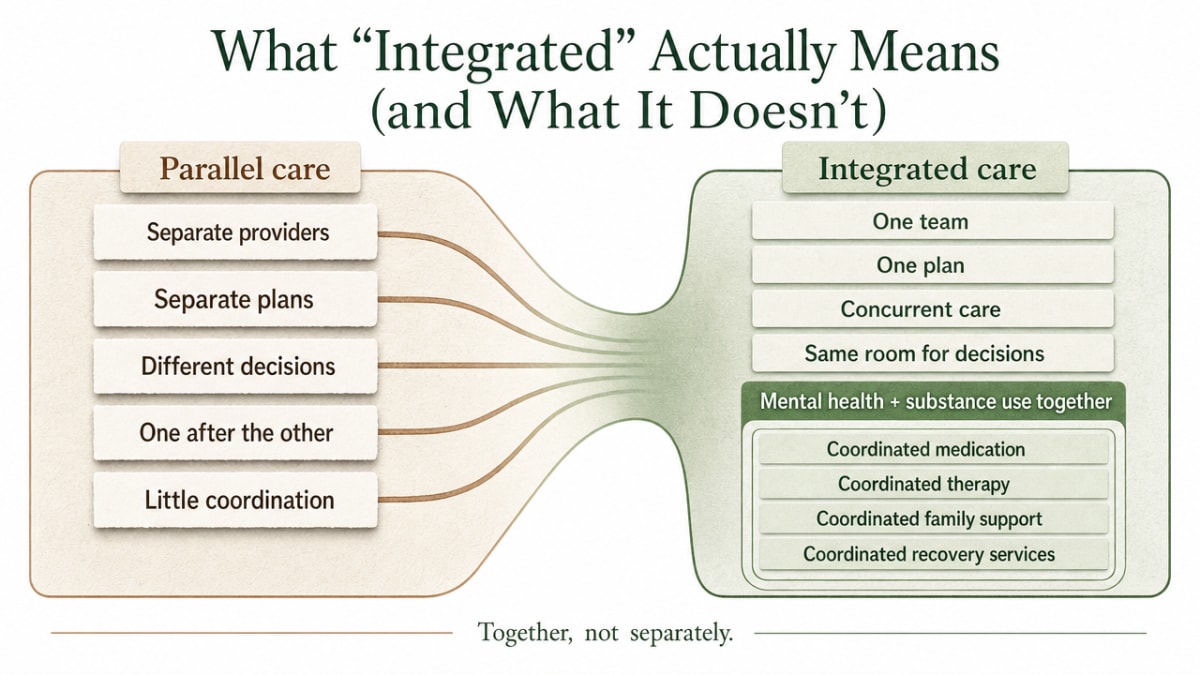
Integrated care means one clinical team is treating both your substance use and your mental health condition at the same time, from the same plan, with the same people in the room when decisions get made. Not a counselor over here and a prescriber over there who have never spoken. The same team.
SAMHSA frames this as concurrent treatment rather than sequential — mental health care and substance use care happening together, not one after the other, and coordinated across medication, therapy, family support, and recovery services 14. NIDA puts it more plainly: treating both conditions at the same time generally produces better outcomes than treating them separately, in part because the symptoms overlap and change as you stabilize 1.
In practice, that looks like a few specific things:
- One intake that asks about both your drinking or drug use and your psychiatric history in the same conversation.
- One treatment plan document that names both diagnoses and lists the interventions for each.
- A psychiatric provider who knows what medication you’re on for withdrawal or cravings, and a substance use clinician who knows what you’re taking for depression, anxiety, PTSD, or bipolar.
- Weekly team communication that doesn’t require you to be the messenger.
Parallel Care Dressed Up as Integrated
Parallel care is the most common thing you’ll encounter, and it often gets labeled as integrated because both services technically exist in the same building or network. They don’t actually run together.
Here’s the side-by-side worth keeping in your head. Integrated care: one team, one shared treatment plan, concurrent psychiatric and substance use services, a single assessment that covers both. Parallel care: two separate teams, two plans that may contradict each other, services delivered in sequence or on different days with no shared handoff, and duplicate intakes where you fill out the mental health paperwork on Tuesday and the substance use paperwork on Thursday. SAMHSA names integrated treatment as the preferred model specifically because the parallel version leaves gaps that the two conditions exploit 14. NIDA has found that integrated treatment for co-occurring substance use and mental illness is consistently better than treating each diagnosis in isolation 2.
Watch for these warning signs when someone tells you a program is “dual diagnosis”:
- Your psychiatrist and your substance use counselor have never spoken and don’t share notes.
- You’re told to “get stable” from substance use first and come back for the mental health piece later.
- The treatment plan has one diagnosis on it, not both.
- You’re explaining your medications to the people who are supposed to be prescribing them.
If any of that sounds familiar, you’re in parallel care. It can still help. It is not what the research is pointing to when it says integration works.
Why the Two Conditions Feed Each Other
You’ve probably noticed the pattern already. The drinking gets heavier when the anxiety spikes. The depression deepens the morning after. A trauma flashback sends you reaching for something that will shut it off for a few hours, and then the shame of that pulls the depression down another notch. The two conditions aren’t sitting next to each other. They’re wired together.
NIDA describes this overlap directly: symptoms of substance use, withdrawal, trauma, and mental illness blur into each other, which is part of why diagnosis is hard and why a single assessment at one point in time often misses what’s actually going on 1. Someone in acute withdrawal can look severely depressed. Someone with untreated PTSD can look like they have a primary substance use problem. Both might be true. One might be driving the other. Usually it’s both, pulling in both directions.
This is why sequencing care almost never works for you. If a program says, “Get six months sober, then we’ll look at the trauma,” the trauma is the reason the sobriety won’t hold. If a prescriber treats the depression but no one addresses the nightly drinking that’s blocking the medication from working, the depression doesn’t lift and the drinking gets blamed on “treatment resistance.” NIDA’s review of common comorbidities found that integrated treatment has been consistently better than treating each diagnosis in isolation, precisely because the conditions interact in real time 2.
You don’t have two separate problems taking turns. You have one situation with two names on it. The plan has to reflect that.
What Honest Evidence Says About Outcomes
You deserve the real version of what research shows, not a brochure version. The honest picture is that integrated care is the model experts prefer, and the evidence for any single therapy inside it is messier than most treatment websites admit.
A 2024 umbrella review that pulled together 30 systematic reviews on psychosocial treatment for adults with co-occurring substance use and mental health disorders found that integrated treatment was generally better than treating only one condition, and sometimes better than parallel, uncoordinated care. The same review also found so much variation in interventions, populations, and outcome measures that the authors could not point to one therapy as universally superior 15. A peer-reviewed guideline review reached a similar conclusion: integrated models are widely viewed as offering the best outcomes and cost-effectiveness, but comprehensive, high-quality clinical guidance across every combination of diagnoses remains limited 5.
Here’s the part that matters for your plan. A Department of Veterans Affairs evidence brief on comorbid PTSD and substance use disorders found that treating one condition does not automatically improve the other. Improvement in PTSD symptoms, for example, does not reliably reduce drinking or drug use on its own 4. That cuts both ways. The depression medication is not going to fix the opioid use. The six weeks sober are not going to lift the trauma. Both have to be worked on at the same time, by people who are actually talking to each other.
So when you hear a program promise outcomes, listen for the hedge. A provider who tells you integrated care gives you a better shot while being honest that the evidence varies by condition is being straight with you. That’s who you want in the room.
What a Real Dual Diagnosis Plan Includes
Assessment, Psychiatric Review, and Medications
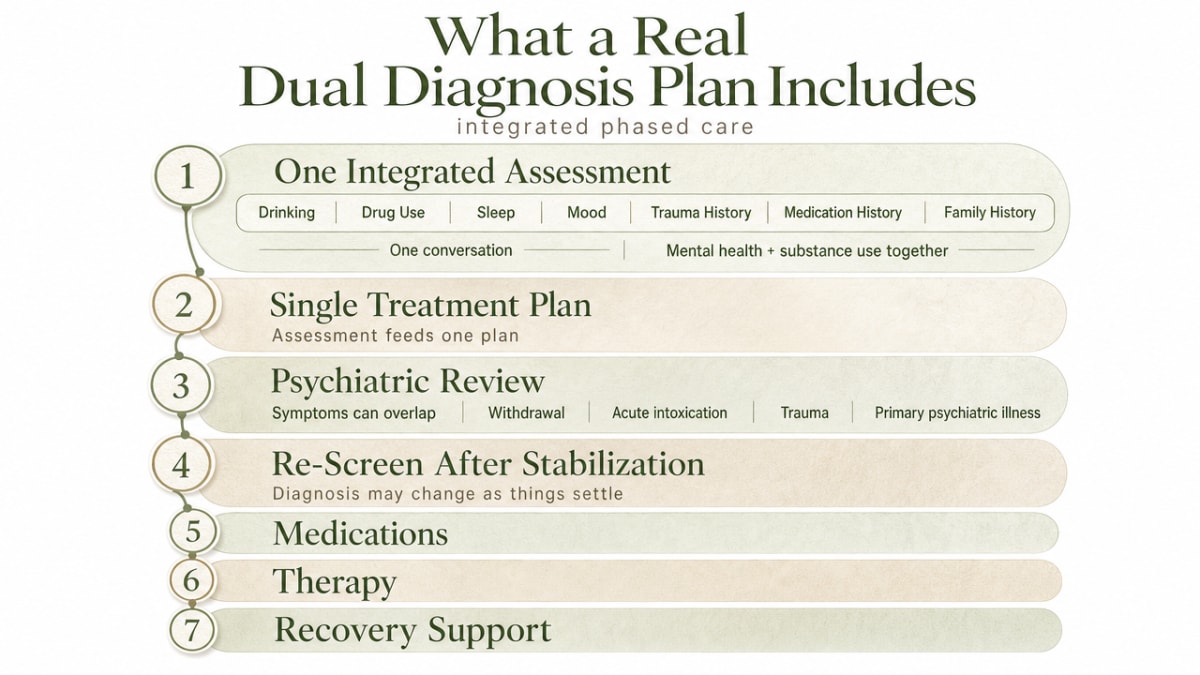
A real plan starts with one assessment that covers both sides. Not a substance use intake on Monday and a mental health screening three weeks later. One sit-down where someone asks about your drinking, your drug use, your sleep, your mood, your trauma history, your medication history, and your family history in the same conversation. SAMHSA’s TIP 42 framework describes this as the foundation of integrated care: screening and assessment that look at mental health and substance use together, then feed a single treatment plan 14.
Expect that assessment to get revisited. NIDA warns that symptoms of withdrawal, acute intoxication, trauma, and primary psychiatric illness overlap enough that a one-time diagnosis often misses what’s actually driving things 1. A good team re-screens after you’ve had some time stabilized, because what looks like major depression in week one can look different in week four when the alcohol is out of your system.
Psychiatric review belongs in the first days, not weeks later. If opioids are part of the picture, the CDC lists buprenorphine, methadone, and naltrexone as the three FDA-approved medications for opioid use disorder, and recommends naloxone and overdose-reversal education for you and the people you live with 9. Those medications sit alongside, not instead of, whatever’s being prescribed for depression, anxiety, PTSD, or bipolar.
Therapy, Trauma Work, and Recovery Support
Therapy in a real dual diagnosis plan is not a generic group three times a week. It’s structured work on both conditions, by clinicians trained in both. NIDA points to cognitive behavioral therapy, family therapy, and trauma-focused approaches like Seeking Safety as interventions with a track record in co-occurring populations 2. You should know which model your therapist uses and why that model was chosen for your diagnoses.
Trauma work needs to be paced. If PTSD is in the picture, pushing into trauma processing before you have coping skills and some stability tends to make the drinking or using worse, not better. A good clinician will tell you that out loud and sequence the work accordingly. They will also tell you that resolving the trauma does not automatically resolve the substance use — the two have to be worked on in parallel inside the same plan.
Recovery support rounds it out. Peer support, family education, case management, and a continuing-care plan that names who you call at week two, week six, and month three. NIMH is direct about this: when you’re seeking help, look for providers experienced in treating both substance use and mental disorders, and disclose both sides of what’s going on from the first call 3. The plan is only as integrated as the information you give it.
Levels of Care and When Great Falls Can’t Deliver Them
Dual diagnosis care isn’t one setting. It’s a continuum, and your situation decides where you start.
- Medical withdrawal management when your body needs to come down safely.
- Residential when you need to be out of the environment that’s keeping both conditions active.
- Partial hospitalization when you need daily structure but can sleep at home.
- Intensive outpatient when you can hold a job but need serious clinical hours.
- Standard outpatient and continuing care for the long middle stretch.
Montana’s Medicaid program has been expanding coverage across this ASAM continuum, including clinically managed residential withdrawal management and higher-intensity residential treatment 10.
Here’s the Great Falls reality. The DPHHS and WICHE analysis found no crisis-receiving facility in the Cascade County system it reviewed, and it named withdrawal management and sobering services as major gaps across the counties studied 6. That means the two levels of care most people need first — somewhere to detox safely and somewhere to land during a psychiatric crisis — are the two the local continuum is shortest on. The ED stabilizes you. It doesn’t run a seven-day withdrawal protocol with concurrent psychiatric medication management.
The urgency is not theoretical. Cascade County coroner-submitted overdose cases ran 12 in 2020, 6 in 2021, 14 in 2022, 7 in 2023, 8 in 2024, and 11 in 2025 per the Montana Medical Examiner’s report, which cautions that these counts include only coroner-submitted autopsies and are not a complete county total 7. The number bounces year to year, but it does not go to zero. And a statewide DPHHS notice flagged a sharp increase in suspected opioid overdoses in early 2025, with Cascade among the counties affected 8.
Questions to Ask an Intake Coordinator
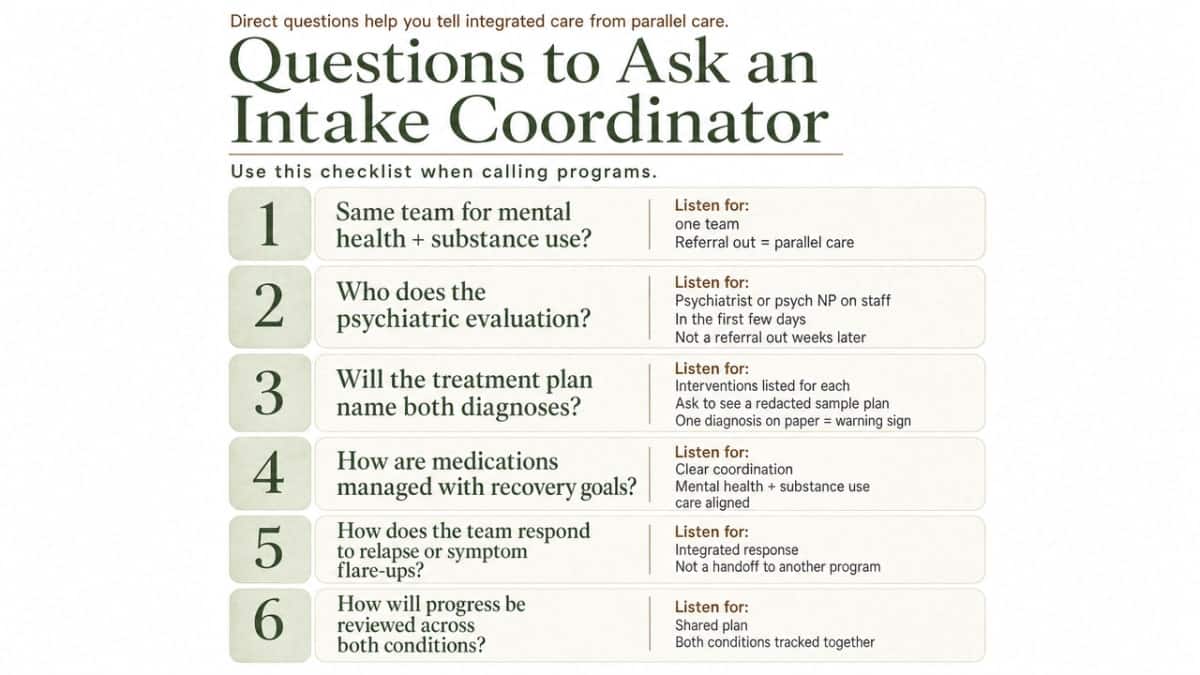
The intake call is where you find out whether a program is actually integrated or just says it is. You don’t need a clinical background to tell the difference. You need a short list of direct questions and the patience to wait for direct answers.
Ask these, in roughly this order:
- “Will the same team treat both my mental health condition and my substance use, or will I be handed off to a separate program for one of them?” Listen for one team. If the answer involves a referral out, that’s parallel care 14.
- “Who does the psychiatric evaluation, and when does it happen?” You want a psychiatrist or psychiatric nurse practitioner on staff, seeing you in the first few days, not a referral out two weeks in 1.
- “Will my treatment plan name both diagnoses and list interventions for each?” Ask to see a sample redacted plan. One diagnosis on paper means one diagnosis in practice.
- “How do my therapist and prescriber share information?” Weekly team meetings and a shared chart. Not “we’ll loop them in.”
- “If I’m on opioids or drinking heavily, how is medical withdrawal handled?” The CDC-approved options for opioid use disorder are buprenorphine, methadone, and naltrexone, and overdose education with naloxone should be part of discharge 9.
- “What’s the plan for week two after I leave?” A real answer names a provider, a date, and who makes the call.
If a coordinator gets defensive or vague on any of these, that tells you something. You’re allowed to hang up and call the next number. Formal clinical guidance across every combination of co-occurring diagnoses is still fragmented 5, which means the burden of asking falls on you more than it should. Ask anyway.
Paying for Care in Montana
Money is the question that stops a lot of good plans before they start. Here’s the honest shape of what’s available to you in Montana, without the benefits-lecture tone.
If you have Montana Medicaid, dual diagnosis care is on the list. The 2026 Montana Medicaid Member Guide includes screening and assessment, medication-assisted treatment, counseling, medication management, recovery support, and clinically managed residential treatment among covered substance use services, as long as the care is medically necessary and the provider is enrolled with Medicaid 11. On the mental health side, Montana’s HEART Waiver expansion has added coverage across the ASAM continuum, including clinically managed residential withdrawal management and higher-intensity residential treatment 10. That matters because the levels of care most relevant to a serious dual diagnosis situation are the ones the state has specifically been working to pay for.
Coverage on paper is not the same as a bed on Tuesday. You’ll still need prior authorization for most residential admissions, the provider has to be enrolled, and medical necessity has to be documented. Ask the intake coordinator to walk you through their authorization process before you commit — not after.
If you have private insurance through an employer or the marketplace, the 2024 federal parity final rules are on your side. Plans are not allowed to impose stricter limits on mental health or substance use benefits than they do on medical and surgical benefits, and they have to look at their own access data and fix it when care isn’t actually reachable 13. In practice, that means a plan can’t quietly require three failed outpatient attempts before authorizing residential dual diagnosis care if it wouldn’t require the same hoops for a comparable medical admission. If a denial feels off, ask for the written medical necessity criteria and the comparative analysis. You’re allowed to appeal.
When Traveling for Residential Care Makes Sense
Leaving Great Falls for treatment is not a failure of your city. It’s a response to what the city can and can’t put under one roof right now. If your situation needs medically supervised withdrawal, same-week psychiatric evaluation, and a residential setting where the therapy and the prescribing happen on the same team, and the local continuum can’t line those up together, driving a few hours is a clinical decision, not a dramatic one.
Travel starts making sense when a few things are true at once:
- You need medical withdrawal management and the local options are thin 6.
- Opioids or heavy alcohol are in the picture and buprenorphine, methadone, or naltrexone need to be started and monitored alongside psychiatric medication 9.
- Outpatient attempts haven’t held because the environment you go home to each night is part of what’s keeping both conditions active.
- A psychiatric prescriber and a substance use clinician who actually share a chart aren’t available locally within a reasonable timeline.
A residential program outside Great Falls can offer what a split local plan can’t: concurrent care, one team, and distance from the triggers that keep pulling you back. That’s the trade-off worth weighing honestly.
The Next Concrete Step
You don’t need a perfect plan today. You need one phone call that moves things forward.
Pick one number. It can be a program’s intake line, your primary care provider, or 988 if you or someone you love is in crisis right now. When you call, say both parts out loud: the mental health piece and the substance use piece. NIMH is clear that disclosing both sides from the first conversation is what gets you connected to providers who treat both 3.
Then ask the questions from the intake section earlier in this article. Write the answers down. If one program doesn’t fit, try the next. You are allowed to be particular about this. The team that treats you should be a team that actually talks to each other — and Elk Ridge Recovery is one option when the local continuum can’t line that up.
Speak Directly With a Dual Diagnosis Specialist Today
Connect now for tailored support and guidance on integrated dual diagnosis care in Great Falls.
Frequently Asked Questions
What’s the difference between dual diagnosis treatment and regular substance use treatment?
Regular substance use treatment focuses on the drinking or drug use. Dual diagnosis treatment addresses both the substance use and a mental health condition like depression, anxiety, PTSD, or bipolar in the same plan, with one team coordinating medication, therapy, and recovery support. SAMHSA frames this concurrent approach as the preferred model because the two conditions interact and sequential care tends to miss what’s driving things 14.
Can I get integrated dual diagnosis care in Great Falls, or do I need to travel?
Some outpatient services exist locally, but a Montana DPHHS and WICHE analysis found no crisis-receiving facility in the Cascade County system it reviewed and named withdrawal management and sobering services as major gaps 6. If you need medical withdrawal, same-week psychiatric evaluation, and a residential setting where therapy and prescribing happen on one team, traveling to a residential program outside Great Falls is often the honest match for the care you need.
Does Montana Medicaid cover dual diagnosis treatment?
Yes, for medically necessary care delivered by an enrolled provider. The 2026 Montana Medicaid Member Guide lists screening, medication-assisted treatment, counseling, medication management, recovery support, and clinically managed residential treatment among covered services 11. The HEART Waiver expanded coverage across the ASAM continuum, including residential withdrawal management 10. Prior authorization usually applies, so ask the intake coordinator to walk you through their authorization process before you commit.
What should I tell the intake coordinator when I call?
Say both parts out loud. The mental health symptoms you’re dealing with, the diagnoses you’ve been given, the medications you take, and the substance use pattern — honestly. NIMH is direct that disclosing both sides from the first conversation is what connects you with providers experienced in treating both 3. Then ask whether one team handles both, when the psychiatric evaluation happens, and whether your treatment plan will name both diagnoses.
Will treating my mental health condition fix the substance use on its own?
Usually not. A Department of Veterans Affairs evidence brief on comorbid PTSD and substance use disorders found that improvement in one condition does not reliably produce improvement in the other 4. Treating the depression or trauma matters, but the drinking or drug use needs its own targeted work at the same time. That’s the whole reason integrated care exists — both get worked on in parallel, inside one plan, by people who talk.
What happens if I need medical withdrawal management before starting treatment?
If opioids or heavy alcohol are in the picture, withdrawal should be medically supervised before outpatient therapy starts. The CDC lists buprenorphine, methadone, and naltrexone as the three FDA-approved medications for opioid use disorder and recommends naloxone and overdose-reversal education for you and your household 9. Because Cascade County’s local withdrawal-management capacity is thin 6, a residential program that handles detox and concurrent psychiatric care under one roof is often the safer first stop.
References
- Co-Occurring Disorders and Health Conditions. https://www.nida.nih.gov/research-topics/co-occurring-disorders-health-conditions
- Common Comorbidities with Substance Use Disorders. https://nida.nih.gov/sites/default/files/1155-common-comorbidities-with-substance-use-disorders.pdf
- Finding Help for Co-Occurring Substance Use and Mental Disorders. https://www.nimh.nih.gov/health/topics/substance-use-and-mental-health
- Evidence Brief: Treatment of Comorbid Conditions. https://www.hsrd.research.va.gov/publications/esp/comorbid-conditions-brief.pdf
- Concurrent (Dual) Disorder Management Guidelines. https://pmc.ncbi.nlm.nih.gov/articles/PMC13117480/
- Montana Crisis Services: Planning for Crisis Receiving and Stabilization Facilities. https://dphhs.mt.gov/assets/BHDD/AdultMHGeneralDocs/MontanaCrisisFacilitiesPlanningReport.pdf
- Montana Medical Examiner 2025 Report. https://dojmt.gov/wp-content/uploads/2026/06/MT-FSD-2025-ME-Annual-Report.pdf
- State Health Officials Report Significant Increase in Overdoses. https://dphhs.mt.gov/News/2025/April/SignificantIncreaseinOverdoses
- Opioid Use Disorder: Treating. https://www.cdc.gov/overdose-prevention/hcp/clinical-care/opioid-use-disorder-treating.html
- February 26, 2024 HEART Waiver Approval, Part II. https://dphhs.mt.gov/assets/heartinitiative/MTHEARTAmendmentApproval02262024.pdf
- 2026 Montana Medicaid Member Guide. https://dphhs.mt.gov/assets/hrd/MedicaidMemberGuide.pdf
- Behavioral Health and Developmental Disabilities (BHDD) Medicaid Services Provider Manual: Policy 455. https://dphhs.mt.gov/assets/BHDD/SubstanceAbuse/455_MCT_eff.3.8.25.pdf
- Departments of Labor, Health and Human Services, Treasury Issue Final Rules Strengthening Access to Mental Health and Substance Use Disorder Benefits. https://www.cms.gov/newsroom/press-releases/departments-labor-health-and-human-services-treasury-issue-final-rules-strengthening-access-mental
- Substance Use Disorder Treatment for People with Co-Occurring Disorders. https://library.samhsa.gov/sites/default/files/pep20-06-04-006.pdf
- Effectiveness of psychosocial interventions for adults with substance use disorder that have a co-occurring mental health disorder: an umbrella review and illustrative cost-effectiveness analysis. https://www.ncbi.nlm.nih.gov/books/NBK623438/
- Health Workforce Shortage Areas. https://data.hrsa.gov/topics/health-workforce/shortage-areas
- SUDORS Dashboard: Fatal Drug Overdose Data – Accessible Version. https://www.cdc.gov/overdose-prevention/data-research/facts-stats/sudors-dashboard-fatal-overdose-data-accessible.html
- Provisional Drug Overdose Death Counts. https://www.cdc.gov/nchs/nvss/vsrr/drug-overdose-data.htm